
AI Automation in Xinjiang Textile Factories Explained: Are “Unmanned” Mills With 5,000 Looms Real?

You’ve Probably Seen the Videos about Xinjiang Textile Factories, But What’s Actually Real?
Social media videos show a factory in Aral reportedly running 5,000 looms 24/7 on automation. These posts have been shared on platforms like Facebook and Instagram, though independent verification is limited. You’re probably wondering how much of that is real and how much is exaggeration.
The short answer is this: AI automation is scaling fast in Xinjiang’s textile sector, but the reality is more complex and more interesting than the headlines suggest.
Some reports go further, suggesting thousands of looms operating 24/7 inside a single facility in the Aral Economic and Technological Development Zone. It looks impressive, almost unsettling, and naturally raises questions:
- Is this really happening?
Are these factories fully automated? - Is AI actually running the show, or is that an exaggeration?
Let’s slow this down and walk through what’s confirmed, what’s partially true, and what’s being overstated so you get the full picture, not just the headlines.
So, Is AI Automation in Xinjiang’s Textile Sector Really Scaling?
Yes, automation is scaling fast, especially in textile manufacturing hubs like Aral.
But no, it’s not the sci-fi version many people imagine.
What’s happening is a rapid expansion of advanced industrial automation, where factories rely on:
- Thousands of automated jet looms
- Centralized digital control rooms
- Continuous 24-hour production cycles
- Far fewer on-floor workers than in traditional textile mills
From a distance, this looks like AI taking over. In reality, it’s a highly optimized, software-driven production system with human oversight.
Why Aral Keeps Showing Up in These Reports
You’ll notice one location mentioned again and again: Aral.
That’s because Aral has been developed specifically as a large-scale industrial and textile manufacturing zone, designed for standardized, high-volume production.
Local coverage and regional industry reporting confirm that textile factories in this zone have:
- Installed thousands of modern looms in single facilities
- Shifted to round-the-clock production
- Integrated digital systems that monitor output, downtime, and maintenance
- Reduced the need for workers to stand beside machines
This is why Aral is often cited when people talk about “unmanned” or “AI textile factories,” even though the reality is more nuanced.
The “5,000 Looms” Claim: What You Should Know
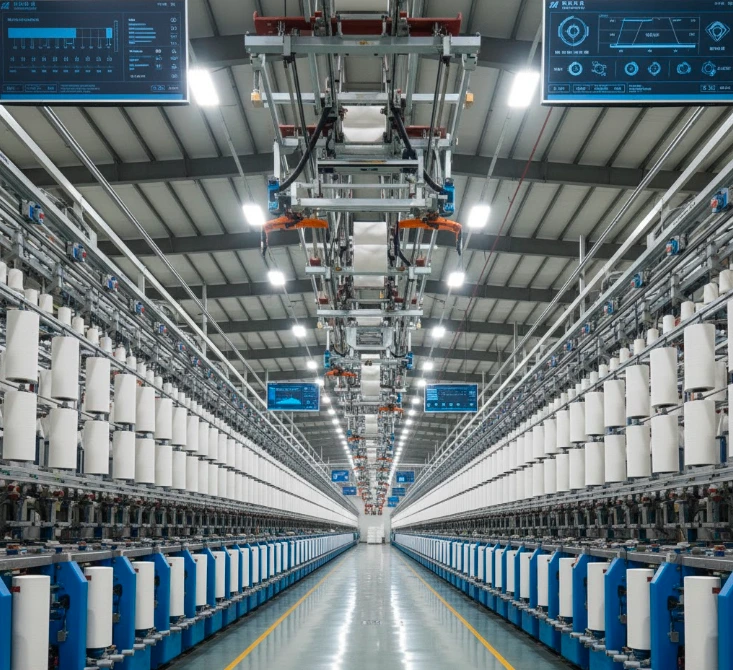
You may have seen claims that a single factory in Aral runs around 5,000 looms nonstop.
Here’s the honest breakdown:
- Large loom installations are real and documented by local reporting
- Exact numbers like 5,000 are harder to independently verify
- Visual evidence shows scale, but official audits rarely publish exact machine counts
So when you hear “5,000 looms,” think of it as a representative scale, not a precise, universally confirmed figure.
The key takeaway isn’t the exact number; it’s that these are massive, highly automated operations, far beyond traditional textile mills.
What Makes These Factories Feel “Almost Unmanned”?
If you walked into one of these facilities, the first thing you’d notice is how quiet and orderly it feels compared to older textile factories.
That’s because:
- Looms are automatically calibrated
- Faults trigger digital alerts, not shouted instructions
- Operators monitor hundreds of machines from control rooms
- Maintenance teams intervene only when needed
You’re not seeing robots replacing humans completely.
You’re seeing humans stepping back from constant manual supervision.
Is This Really AI — or Just Very Advanced Automation?
This is where a lot of confusion comes from.
What is being used:
- Digital production management systems
- Sensor-driven monitoring
- Predictive maintenance software
- Data-based efficiency optimization
What isn’t happening:
- Machines making independent decisions
- Self-learning systems redesigning production
- Fully autonomous factories with no human control
In simple terms, AI helps optimize, but automation runs the factory.
Calling it “AI automation” isn’t wrong; it’s just broader than people assume.
Why China Is Pushing “Lighthouse” Smart Factories
You might also hear these factories described as “lighthouse” smart factories.
That term is used in China to describe model facilities that demonstrate:
- High efficiency at scale
- Full digital integration
- Replicable factory designs
- Lower labor intensity
Aral’s textile projects are often highlighted because they fit this model, not because they’re experimental, but because they’re designed to be copied elsewhere.
What This Means for the Textile Industry (And Why It Matters to You)
From a business and industry perspective, this shift matters because it shows where textile manufacturing is heading:
- Higher output with fewer workers
- More predictable production
- Lower downtime
- Greater global competitiveness
If you’re watching global manufacturing trends, Xinjiang’s textile automation, especially in places like Aral, is a real-world example of industrial scaling, not a futuristic demo.
Also Read: Can Neuralink Let You Control Tech With Your Brain in 2025?
The Bottom Line (What You Should Take Away)
If you were expecting sci-fi AI factories, the reality may feel underwhelming.
If you were looking for proof that large-scale automation is already reshaping manufacturing, this is it.
Xinjiang’s textile sector, especially in Aral, shows how thousands of machines can run nonstop, controlled digitally, with humans supervising from a distance.
It’s not futuristic fantasy.
It’s industrial automation at scale, and it’s already happening.
FAQs
1. Is Xinjiang really using AI in textile factories?
Yes. Textile factories in Xinjiang are using AI-assisted automation and digital control systems to monitor production, detect faults, and optimize efficiency. Most operations rely on advanced industrial automation rather than fully autonomous AI, making independent decisions.
2. How automated are textile factories in Xinjiang?
Many textile factories in Xinjiang operate thousands of automated looms, run 24 hours a day, and use centralized control rooms. Human workers mainly supervise systems, handle maintenance, and manage quality instead of operating each machine manually.
3. Are there factories in China running thousands of looms 24/7?
Yes. Large textile factories in China, including those in Aral Economic and Technological Development Zone, operate thousands of looms continuously using automated production systems and digital monitoring to support round-the-clock manufacturing.
4. Are Xinjiang textile factories fully unmanned?
No. While automation significantly reduces on-floor labor, human oversight is still required. Engineers, technicians, and supervisors monitor systems, perform maintenance, and manage production quality, even in highly automated textile facilities.
5. What does “AI automation” mean in textile manufacturing?
In textile manufacturing, “AI automation” usually refers to software-driven monitoring, predictive maintenance, and efficiency optimization. Machines follow programmed logic, while AI tools assist by analyzing data and improving performance rather than replacing human decision-making.
6. What is a lighthouse factory in China?
A lighthouse factory is a model smart factory that showcases advanced automation, digital integration, and high efficiency at scale. These factories are designed to demonstrate best practices that can be replicated across industries and regions.
7. Why is Aral frequently mentioned in reports about textile automation?
Aral is frequently mentioned because it hosts large, purpose-built textile manufacturing zones designed for high-volume automated production. Its factories combine scale, centralized digital control, and continuous operation, making it a visible example of China’s textile automation push.
Similar Posts
Top 17 Australian Tech Leaders Driving AI Innovation in 2026
How to Fix Smart Square HMH Login Issues Quickly
30% Rule in AI | Don’t Rely 100% on AI Tools | Human Input Still Matters