

How to Choose the Right Power Bank Capacity for Travel
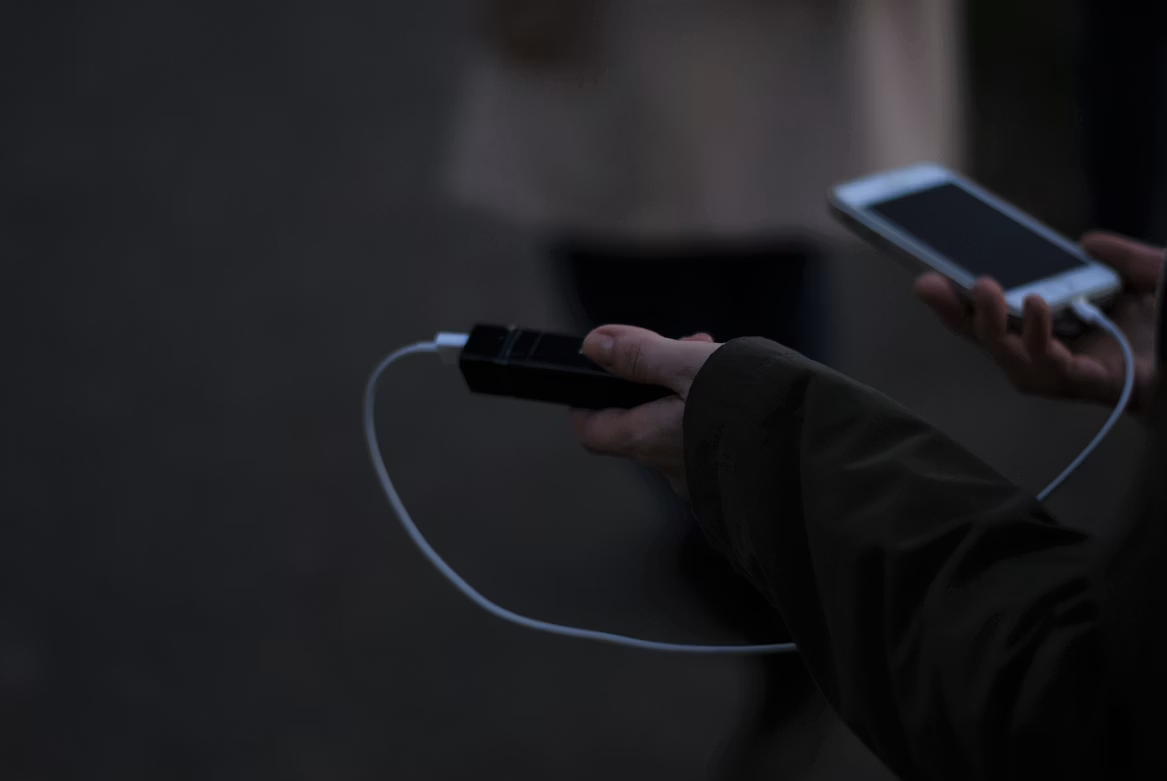
There’s a particular kind of dread that hits when your phone battery hits 8% at an airport gate, a foreign train station, or somewhere deep in a national park with no outlet in sight. A power bank fixes that problem, but only if you choose the right one before you leave home.
Walk into any electronics store in Australia, and the range is overwhelming. Capacities ranging from 5,000mAh to 50,000mAh, output specs buried in fine print, and prices that don’t always correlate with quality. Choosing by mAh number alone is one of the most common mistakes Australian travellers make, and it leads to either a power bank that’s too small to be useful or one so large it gets flagged at airport security.
This guide breaks down exactly how to match your power bank to your actual travel needs.
Understanding mAh: What the Numbers Actually Mean
mAh stands for milliampere-hour, it’s a measure of stored energy, not speed. A higher mAh number means more total energy stored, which translates to more charges for your devices. But here’s the part manufacturers rarely shout about: conversion loss.
Power banks don’t deliver 100% of their stored capacity to your device. Due to heat generation and voltage conversion from the battery’s internal voltage to the USB output voltage, you typically only get 60–70% of the rated capacity in real-world use. So a 10,000mAh power bank effectively delivers around 6,000–7,000mAh to your device.
The practical upshot:
- 5,000mAh → roughly 1 full charge for a modern smartphone
- 10,000mAh → 2–2.5 charges for a smartphone
- 20,000mAh → 4–5 charges for a smartphone, or partial charge for a laptop
- 30,000mAh → 6–8 smartphone charges, or 1–1.5 full laptop charges
The Airline Rule You Cannot Ignore
This is where a lot of Australian travellers get caught out, particularly on international routes.
Airlines operating under IATA regulations, which cover virtually every international flight out of Australia, restrict power banks to carry-on baggage only. They are not permitted in checked luggage under any circumstances. Beyond that, there are capacity limits:
- Up to 100Wh (roughly 27,000mAh at 3.7V): permitted in carry-on without airline approval
- 100–160Wh: permitted in carry-on with airline approval, maximum 2 units
- Above 160Wh: banned from passenger aircraft entirely
The takeaway is simple: if you’re buying a power bank primarily for air travel, the sweet spot is under 27,000mAh to fly without having to seek approval. This is one of the reasons the 20,000–27,000mAh range is so popular with frequent flyers: maximum practical capacity, no airport drama.
Matching Capacity to Your Travel Style
- The weekend warrior (domestic flights, short trips): A 10,000mAh unit is enough for most people doing 1–2 night trips. It’ll keep your phone alive through a day of navigation, photography, and messaging. Fits in a jacket pocket. At this capacity, prioritise output wattage over raw capacity. A 10,000mAh unit with 18W+ USB-C PD output charges your phone far faster than a 20,000mAh unit with a 5W output.
- The backpacker or long-haul traveller: This is where capacity matters most. Days between power points, multiple devices, the occasional laptop top-up you need at minimum 20,000mAh, and ideally more. A 30000mAh power bank with 20W output covers smartphone, tablet, and earbuds charging across several days of heavy use. It’s the pick for anyone doing extended travel in Southeast Asia, hiking multi-day trails in Australia’s national parks, or spending long stints on overnight trains and buses.
- The business traveller: Reliability over raw capacity. Look for 20,000mAh with 45W–65W USB-C PD output, dual ports so you can run your phone and laptop simultaneously, and a slim form factor that sits cleanly in a laptop bag. You’re not sleeping in a tent, you just need to survive a full day of meetings and flights without hunting for a power point.
- The daily commuter: Capacity is almost irrelevant here. A 10,000mAh unit or even a compact 5,000mAh option is plenty if you’re charging overnight at home. Focus on build quality, cable compatibility (built-in USB-C cables are genuinely useful for commuters), and pass-through charging so you can recharge the power bank and your phone simultaneously.
Output Wattage: The Spec That Actually Determines Speed
mAh tells you how long a power bank lasts. Wattage tells you how fast it charges your gear.
A 5W output still common on cheap units is slow enough to frustrate even patient people. If you’re trying to top up a laptop, 5W won’t even offset the discharge rate during active use. Here’s a practical guide:
- 5W: Smartphones only, very slowly. Avoid.
- 18W (USB-C PD): Fast charging for all modern smartphones
- 45W: Sufficient for ultrabooks and iPads
- 65W+: Full laptop charging for MacBooks and Windows laptops
Always check the output spec on the specific USB-C port you plan to use. Many power banks advertise a high wattage on the headline, but only deliver it on one port; the second port drops to 5W or 18W when both are in use simultaneously.
What to Look for When Comparing Options
When browsing the range of power banks Australia retailers have available, filter by these criteria before looking at price:
- Certified safety: Look for units with overcharge, over-discharge, and short-circuit protection. Avoid brands with no local presence or warranty. A power bank failure on a flight is not an abstract risk.
- Pass-through charging: Lets you charge the power bank and a connected device at the same time. Not universal, and genuinely useful.
- Number of ports: Two USB-C ports with independent power delivery is the sweet spot for most travellers. USB-A ports are useful for older devices and cables.
- Real-world reviews: Spec sheets are optimistic. Look for reviews that actually test capacity to depletion, not just manufacturer claims.
The Bottom Line
The right power bank for travel is the one that matches your actual itinerary, not just the biggest mAh number you can find. For most Australian travellers doing international flights, a 20,000–30,000mAh unit with 45W–65W USB-C output covers virtually every scenario. Go bigger if you’re travelling without regular access to power points. Go smaller if you’re doing short trips and care about packing light.
Whatever you choose, buy it before you need it. A power bank purchased in a panic at an airport costs three times as much and delivers half the performance.

Similar Posts
Cold Eeze Cooling Ace Review (2026): What You Should Know Before Buying
Is Wcofun TV the Right Choice for Animated Entertainment? An Unbiased Review
How AI Reduces Costs in Healthcare and Boosts Efficiency