
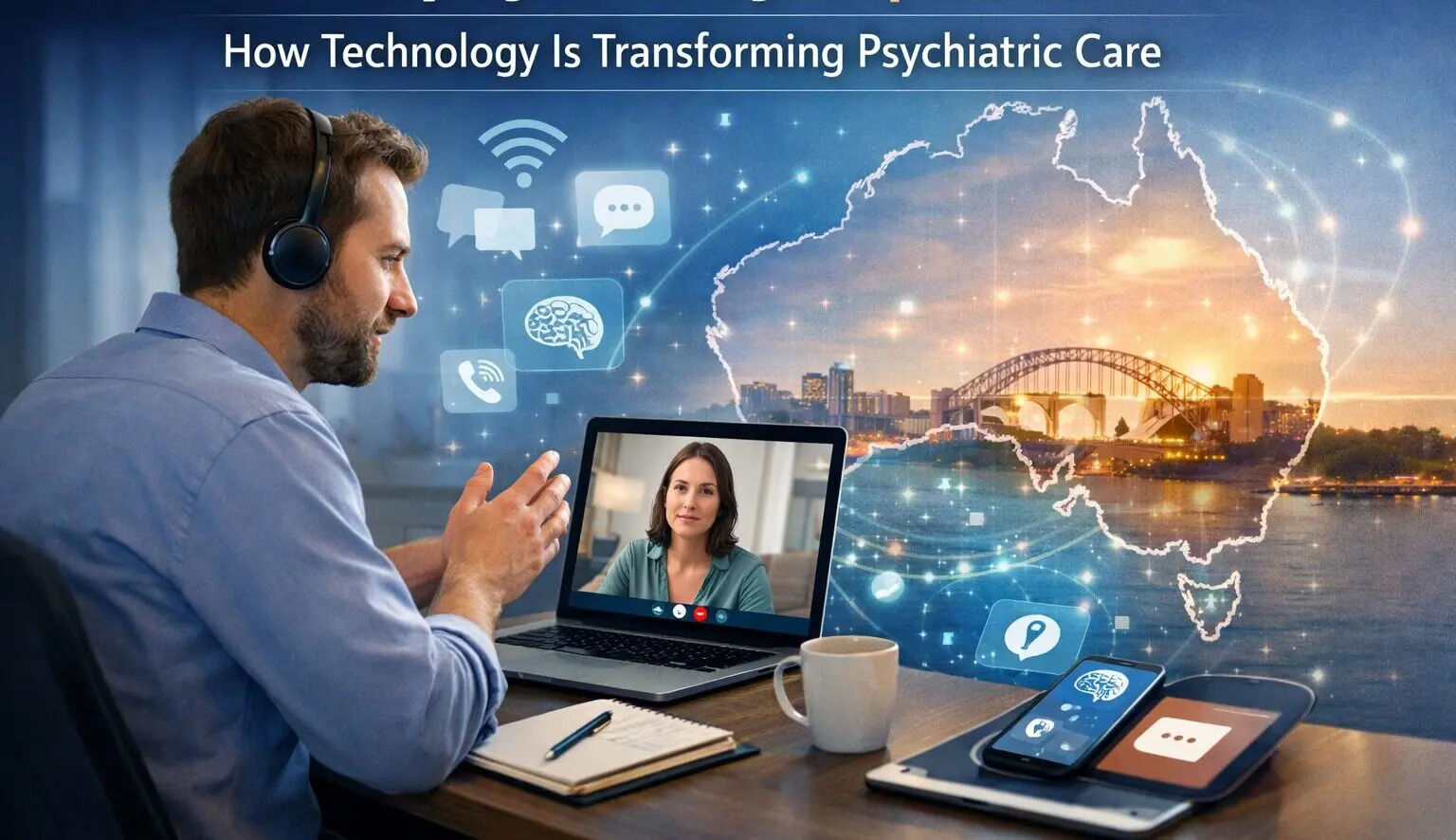
Telepsychiatry Explained: How Technology Is Transforming Psychiatric Care
Disclaimer: This content is for informational purposes only and does not constitute medical advice. Please consult a qualified healthcare professional for diagnosis or treatment.
Digital health has graduated from the experimental phase and is now part of mainstream healthcare. Mental health services/technology, in particular, have been quick to innovate with technology, tackling age-old challenges of accessibility, continuity, and scale. FaceTime appointments have become part of normal care rather than a stopgap measure. This shift is especially critical in the context of a global shortage of mental health professionals according to the WHO, some low-income countries have fewer than 1 psychiatrist per 100,000 people making scalable digital solutions essential. For tech companies developing health care platforms, that revolution is essential for understanding because psychiatric care, increasingly, is the province of software architecture, data security, interoperability, and user experience.
Psychiatry is, after all, an intensely relational field. Diagnosis and treatment depend on knowing the patient long term, clinical acumen, and trust. Technology does not replace the foundation, but it adds in a valuable way to how care is accessed and managed. The contemporary psychiatrist is now working within a digitally mediated environment that facilitates the evaluation, tracking, documentation and follow-up over disparate locales.
The evolution from in-person psychiatry to virtual care
In the past, psychiatry was primarily centered within urban areas and hospitals. Patients in remote or impoverished areas experienced delays, travel difficulties, and a scarcity of options. Telepsychiatry, a solution to these needs, began in a simple form with video consultations. As platforms advanced, they included scheduling, electronic health records (EHR), E‐prescribing, and outcomes tracking.
But that’s not what online psychiatry is today, with video calls tacked on to a traditional practice. It’s a recrafted care model intended to be flexible and scalable. Encrypted messaging tools can enable consultations across time zones, and synchronous messaging helps support continuity between sessions. Patient expectations have evolved, with convenience and immediate access being expected as a given, no longer a differentiator.
Why telepsychiatry is a technology-driven discipline
Psychiatric care is particularly well-suited to the digital delivery system because it relies as much on talking and behavioural observation as on a physical exam. Yet, success relies on solid technical foundations. We must not compromise on platform stability, data privacy and clinical conformance. A telehealth psychiatrist depends on high-quality AV transmission to evaluate affect, cognition, and speech. Even a small delay or information loss affects the accuracy of clinical results.
Systems-wise, they are as important as being able to talk with each other. Telepsychiatry platforms also need to be able to connect with electronic health records, pharmacy networks and diagnostic machines. This seamless integration saves clinicians’ time and paperwork, allowing them to focus on clinical outcomes rather than manual tasks. There’s a need, then, for tech vendors to build APis and architectures that are compliant with the standards of healthcare AND flexible enough to accommodate regulatory shifts.
Expanding access and redefining proximity
One of the ways in which telepsychiatry affects us most is by redefining the concept of proximity. The idea of a psychiatrist near me has evolved from a physical proximity to being digital. Time to access has taken precedence over location, as has continuity of care and personal clinician fit for clients. This trend would have implications on human resource allocation, specialists could serve larger populations and geography without moving around.
For health systems, this scale of influence enhances the ability to plan capacity and reduce wait times. And it normalises mental health care as a routine service, not an extraordinary one, for patients. It is technology that keeps this balance by allowing for secure identity verification, consent management and documentation that all work simultaneously across jurisdictions.
Data, analytics, and personalised psychiatric care
Advanced telepsychiatry systems are more likely to include data analytics for clinical decision making. Using symptom reporting instruments, electronic questionnaires, and longitudinal outcomes monitoring can also yield data that can be analysed for patterns, trends, or treatment response. Although clinical judgment remains indispensable, such lessons will help drive more personalised and proactive care.
Machine learning is starting to aid in triage, risk stratification, and administrative automation. Importantly, ethical implementation is essential. The technology must be an enhancement to, rather than a replacement for, the clinician. It is important to consider transparency, explainability, and bias attenuation for any type of platform in this space.
Future technology trends every psychiatrist should know in 2026
In the future several technology trends may continue to revolutionise psychiatric care. That ambient clinical documentation would run off natural language processing and thereby decrease administrative burden by turning consultations into structured notes on the fly. This enables the clinicians to look into people’s eyes and share therapeutic presence without distractions.
Remote patient monitoring will also come of age, incorporating wearable data and behaviour patterns into psychiatric assessment. Sleep, activity and medication adherence signals offer early alarm bells for relapse or worsening. These applications support prevention-based care rather than reactive intervention.
Frictionless digital ecosystems will join as the norm. Consumers will expect easy transitions from their primary care provider to mental health and allied health services. For platforms that don’t interoperate, it will be tough to survive. What will define data protection, though, is cybersecurity and compliance, as mental health information continues to be one of the most personal types of personal data.
Finally, clinician experience will be a point of greater focus. Burnout in mental health care has always been a major problem, and poorly designed technology only makes this worse. Next-generation platforms will focus on intuitive, low-cognitive-load, and intelligent automation.
The role of technology partners in mental health innovation
For companies like Appkod, focused on technology solutions, telepsychiatry offers an opportunity to build infrastructure that immediately improves patient care. Success hinges on a close working partnership with clinicians, regulators, and healthcare organisations. Designing for the cacophonous, critical field of mental health care is not just a technical challenge but also a responsibility. Design thinking here shapes matters of safety, equity, and trust.
Flexible and standardised profiles are important in different types of scalable platforms. They must accommodate varying care models and thrive with clinical rigour. Those companies that appreciate the idiosyncrasies of psychiatric workflows will be best placed to provide solutions that are adopted, trusted, and maintained.
In a growing digital mental health landscape, organisations such as HelloDoc are an example of how technology can enable convenient, evidence-based psychiatric care when applied thoughtfully, helping patients access today’s expert mental health services with trust.
FAQs
What sets telepsychiatry apart from traditional psychiatric care?
Telepsych provides the same service but through encrypted digital platforms and without a physical office. Rather, the distinction is one of access and delivery, not clinical standards or quality of care.
Can a psychiatrist arrive at reliable diagnoses online?
Yes. In a psychiatric setting, this is based on clinical interviews and behavioural observations, which would translate well to high-quality digital consultations with appropriate support tools.
What are the technology needs of a safe-by-design telepsychiatry platform?
Alongside these are secure video infrastructure, encrypted data storage, compliant record systems and accurate identity verification. Without them, clinical and malpractice risks go up dramatically.
How does online care increase access to mental health treatment?
Delivery through digital channels is not bound by geography or logistics, and hence patients are likely to be more engaged with care, even earlier in the course of illness.
Will psychiatrists be replaced by technology in the future?
No, technology is meant to be there for humans, not replace them. Psychiatric care remains grounded in human judgment, empathy, and ethical responsibility.
What should you consider when deciding on digital psychiatric services?
Patients should consider doctor-led platforms like this, which place a focus on security, continuity of care and visibility of the consultation process ahead of convenience.
How can tech companies responsibly help provide mental health care?
Tech partners who help build systems that are based in clinical reality, regulatory adherence and patient safety could be the difference makers in the expansion of high-quality psychiatric care around the world.
Similar Posts
Amazon’s Rapid Expansion in Australia Alerts Coles and Woolworths to Competitive Threat
MIP Fund Accounting – A Perfect Accounting software for Non-Profit organizations
Future Weapons Technology: A Deep Dive into Cutting-Edge Advanced and Next-Gen Weapons