
Jobs at Risk from AI in 2026: Real Data Behind Slowing Hiring and Changing Work
AI is not removing jobs all at once.
But it is already changing how many people are needed to do the same work.
That shift is visible right now.
In recent analysis from Anthropic, task-level data shows that in many knowledge-based roles, up to 36% of daily tasks can already be automated or assisted by AI systems like Claude. This does not eliminate roles entirely, but it reduces how much human effort is required.
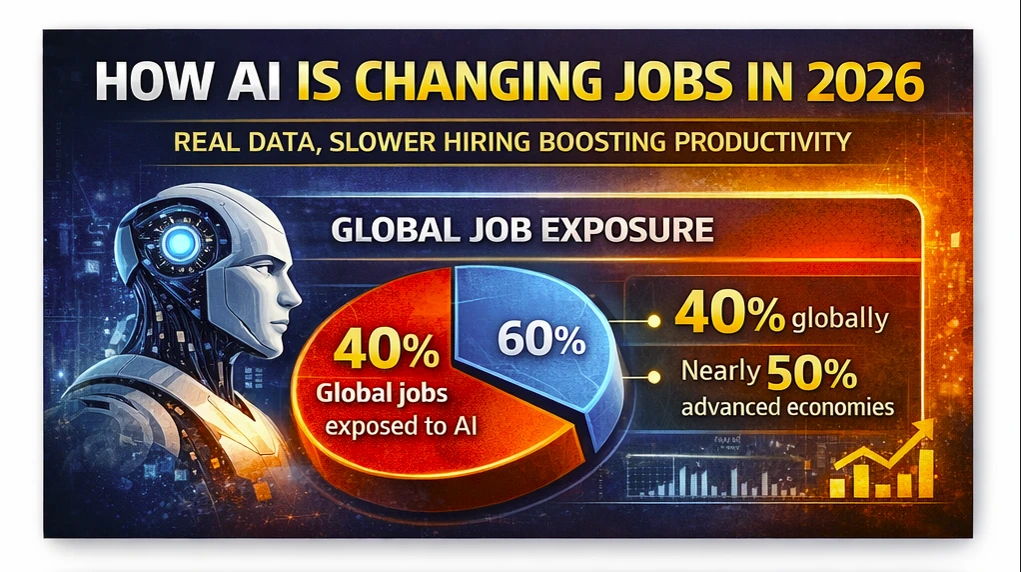
At the same time, broader global data confirms the scale of change. The International Monetary Fund estimates that around 40% of global jobs are exposed to AI, with exposure rising to nearly 60% in advanced economies.
Leading voices in AI are already signaling this shift. Sam Altman has repeatedly emphasized that AI will increase productivity across knowledge work, but higher productivity historically reduces the need for rapid hiring growth. In practical terms, this means companies can scale output without expanding teams at the same pace.
That combination leads to a simple outcome:
Hiring slows before jobs disappear.
This is the real story behind jobs at risk from AI in 2026.
The Key Shift: AI Is Reducing Hiring Demand
The job market is not reacting in the way many expected.
Instead of large layoffs, the early signal is a slowdown in hiring, especially in roles where AI can take over part of the workload.
Recent labor trends show:
- Entry-level hiring in AI-exposed roles has dropped by around 10% to 15%
- Graduates feel the impact up to 4 times more strongly than experienced workers
- Teams are growing more slowly, even when the workload increases
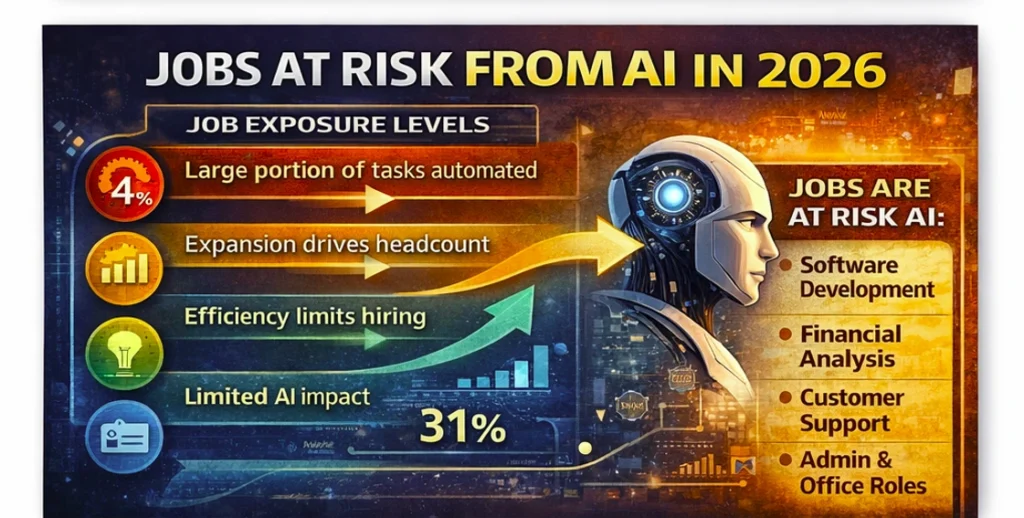
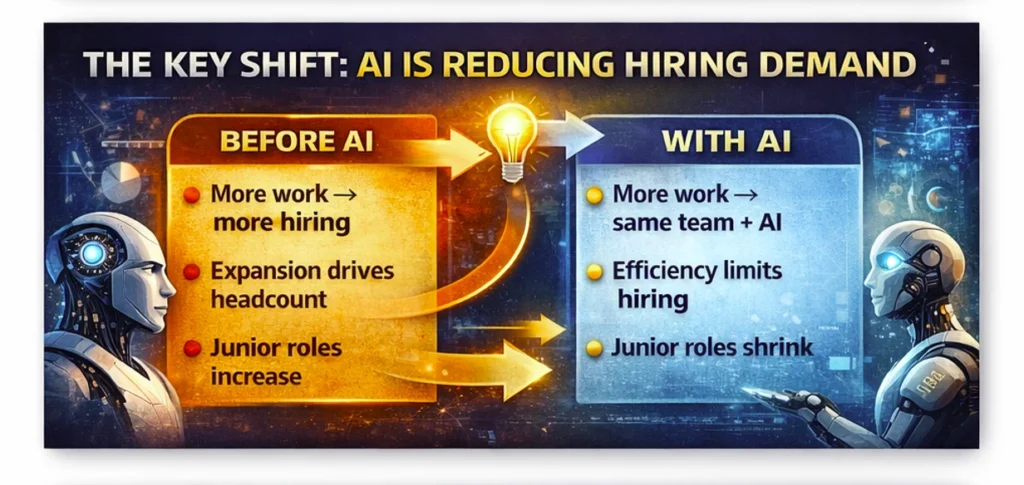
This change comes from a different way of thinking about growth.
| Before AI | With AI |
| More work → more hiring | More work → same team + AI |
| Expansion drives headcount | Efficiency limits hiring |
| Junior roles increase | Junior roles shrink |
This is why the AI hiring slowdown has become one of the most important signals in the labor market.
Satya Nadella has described AI as a “co-pilot for every employee,” highlighting how one worker can now handle tasks that previously required multiple people. This shift directly explains why hiring demand slows even when business activity remains strong.
Jobs at Risk from AI: What the Data Actually Shows
The gap between what AI can do and what companies actually use becomes clearer when broken down by occupation:
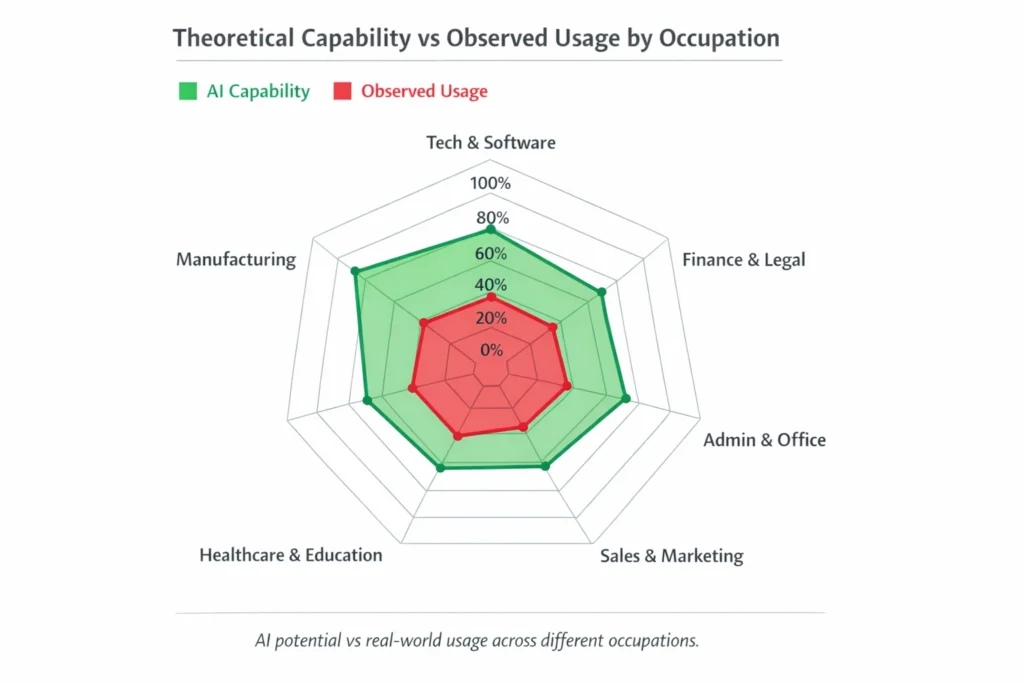
The idea that entire jobs disappear is misleading.
The real change happens at the task level.
From current data:
- Only about 4% of jobs are fully automatable
- Around 60% to 70% of work activities can be partially automated or assisted (McKinsey)
- Most roles fall into a middle category where AI handles part of the work
This creates three layers of exposure:
| Exposure Level | What It Means |
| High exposure | A large portion of tasks is automated |
| Medium exposure | AI assists but does not replace |
| Low exposure | Minimal AI impact |
Most jobs sit in the medium exposure category, where AI reduces workload but does not remove the role.
Dario Amodei has pointed out that modern AI systems are increasingly capable of performing complex knowledge tasks at scale. However, he also stresses that most roles will evolve through partial automation rather than full replacement, reinforcing why task-level disruption matters more than job-level assumptions.
Which Jobs Are Most at Risk from AI
Jobs most affected by AI share a clear pattern. They are built on structured, repeatable, and digital work.
High-exposure roles
- Software development and programming
- Financial analysis and accounting
- Customer service and support
- Administrative and office roles
- Data analysis and reporting
These roles rely heavily on:
- Processing information
- Following defined workflows
- Generating structured outputs
This is where AI performs best.
That is why demand for new hires in these roles is slowing.
Jobs Safe from AI (Short-Term Stability)
A simplified breakdown makes the contrast between high-risk and low-risk roles easier to understand:
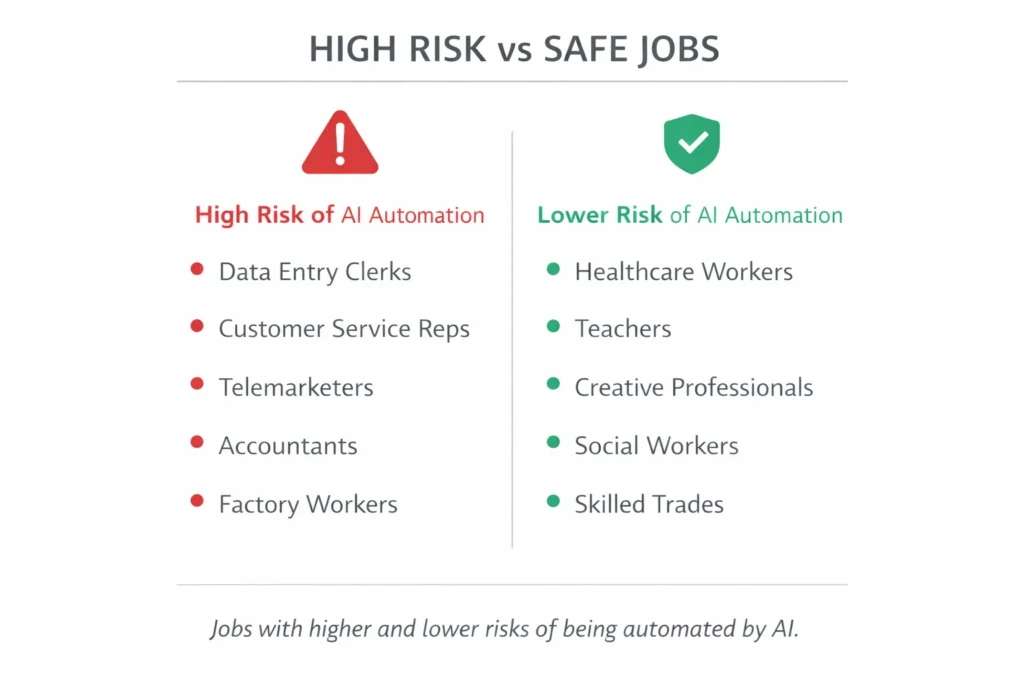
Not all work is equally exposed.
According to IMF estimates, around 30% of jobs remain low-risk, especially those requiring physical presence and real-world interaction.
Lower-risk roles
- Construction and skilled trades
- Healthcare support and caregiving
- Food service and hospitality
- Transportation and logistics
- Field operations
These roles involve:
- Physical execution
- Unpredictable environments
- Real-time human judgment
Automation in these areas is far more complex and costly.
Entry-Level Jobs: Where the Impact Is Strongest
The clearest effect of AI appears at the entry level.
Entry-level work often includes:
- Repetitive tasks
- Data handling
- Basic operational work
These tasks overlap directly with AI capabilities.
That is why hiring patterns are shifting.
| Team Structure | Before AI | After AI |
| Junior hiring | High | Reduced |
| Work distribution | Manual tasks | AI-assisted tasks |
| Productivity expectation | Gradual | Immediate |
This leads to fewer entry points into careers, making early-stage roles more competitive.
This pattern aligns with broader industry expectations. Many AI leaders acknowledge that junior-level work, which traditionally involves repetition and learning through execution, is the most exposed layer. As AI absorbs these tasks, fewer entry points into the workforce naturally follow.
The Bigger Pattern: Labor Compression
To understand AI’s impact on jobs in 2026, one concept explains most of the data:
Labor compression
This means:
- Output per employee increases
- Hiring demand decreases
- Workforce growth slows
Supporting data shows:
- Up to 36% of tasks are already automated or assisted (Anthropic)
- 60–70% of work activities impacted (McKinsey)
- ~40% of jobs are exposed globally (IMF)
👉 These numbers do not indicate job loss directly.
They indicate efficiency replacing expansion.
What Is Happening Inside Companies
The shift is already visible in everyday work environments.
Operational changes
- Hiring approvals take longer
- Teams stay smaller for longer periods
- AI tools handle repetitive workflows
- Employees manage more output individually
Employee-level experience
- Fewer openings in knowledge-based roles
- Higher expectations for AI tool usage
- Increased competition for available positions
The workforce is becoming more efficient and more selective at the same time.
Jensen Huang has highlighted that AI is fundamentally changing how work is performed by amplifying individual productivity. This shift allows smaller teams to achieve results that previously required larger groups, reinforcing the trend toward leaner hiring.
Global Outlook: Job Shifts, Not Just Job Loss
The World Economic Forum projects that by 2027:
- 83 million jobs may be displaced
- 69 million new jobs may be created
This results in a net shift rather than a total collapse.
Roles declining:
- Clerical and administrative positions
- Data entry and routine processing jobs
Roles growing:
- AI specialists
- Data analysts
- Technology-focused roles
Andrew Ng has consistently emphasized that AI will create new categories of work even as it transforms existing ones. The challenge is not the absence of jobs, but the speed at which workers can transition into new roles shaped by AI.
This shows that AI job market trends are about transformation, not elimination.
What This Means for Your Position in the Market
The most important adjustment is not avoiding AI.
It is working with it.
Higher-risk positioning
- Repetitive digital tasks
- Execution-only roles
- Low-complexity workflows
More resilient positioning
- Decision-making roles
- Problem-solving and strategy
- AI-assisted productivity work
The advantage shifts toward those who can combine domain knowledge with AI tools.
Final Insight
Across the industry, there is a clear consensus. AI is not introducing sudden disruption, but gradual restructuring. Productivity gains, task automation, and hiring adjustments are happening together, shaping a labor market that evolves step by step rather than through immediate shocks.
The conversation around jobs at risk from AI often focuses on job loss.
The data points somewhere else.
AI changes how much work each person can do.
That changes how many people companies need to hire.
The result is not immediate disruption.
It is a gradual shift in opportunity.
And that shift has already started.
FAQs
Which jobs are at risk from AI in 2026?
Programming, finance, customer support, and administrative roles show the highest exposure due to structured digital workflows.
Is AI replacing jobs right now?
The primary impact is reduced hiring and changing the job structure rather than immediate job loss.
Which jobs are safest from AI?
Jobs requiring physical work and human interaction remain more stable in the short term.
Why is hiring slowing down due to AI?
Companies are increasing productivity with AI, reducing the need to hire additional workers.
Will AI increase unemployment?
In the short term, it reduces hiring demand. In the long term, it reshapes job roles and creates new categories.
Similar Posts
How to Clear Cache on MacBook Air in a Simple Way
How Cloud Infrastructure Works: Beginner to Advanced Explained
What is a Virtual Appointment with a Doctor?