

How do the AI translation earbuds work: A Breakdown of AI-Powered Speech Translation

Imagine traveling to a new country and speaking your native language while the other person hears you instantly in theirs. This is no longer science fiction. AI translation earbuds are making real-time multilingual communication possible using advanced artificial intelligence, speech recognition, and cloud-based translation systems.
These smart earbuds are becoming essential tools for travelers, business professionals, and global teams who need instant, natural communication without language barriers.
What Are AI Translation Earbuds?
AI translation earbuds are wireless smart earphones that can listen, translate, and speak languages in real time.
They typically work in two modes:
- Conversation Mode: Two people wearing earbuds speak different languages and hear translations instantly
- Assist Mode: One user speaks, and the translation is played through a speaker or phone
Popular examples include smart translation devices powered by AI systems similar to those used in Google Translate and other neural language models.
How AI Translation Earbuds Work (Step-by-Step)
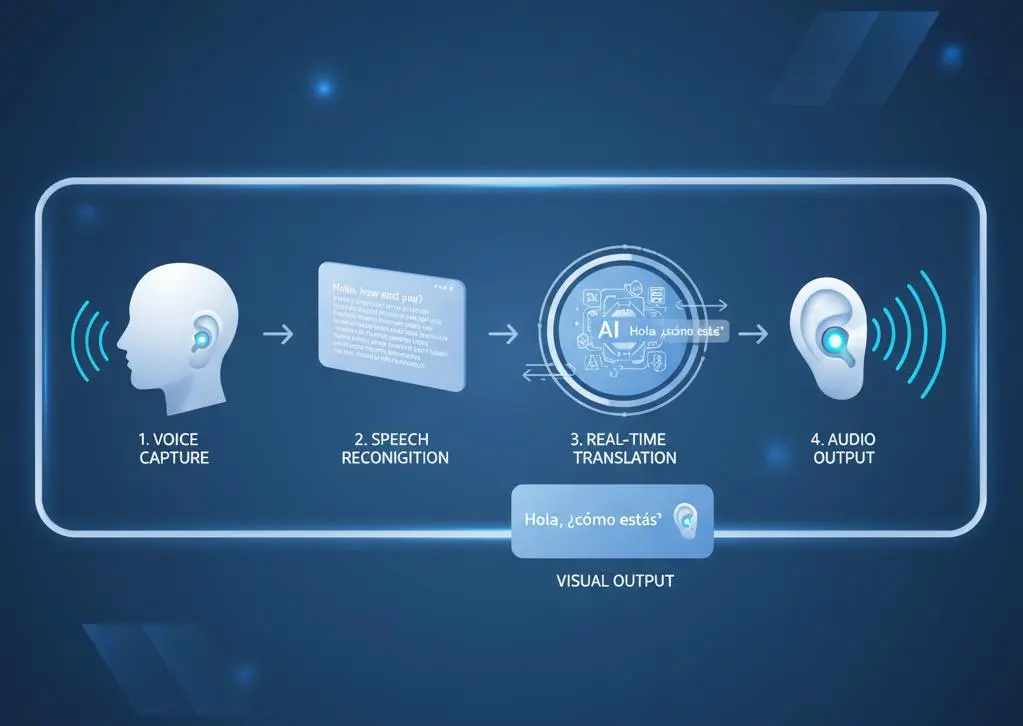
AI translation earbuds rely on a combination of advanced technologies working together in real time.
1. Speech Capture (Microphones)
Tiny microphones inside the earbuds capture spoken words and convert them into digital audio signals.
2. Speech Recognition (ASR – Automatic Speech Recognition)
The audio is processed by AI systems that convert speech into text. This is called speech-to-text conversion.
This step is crucial because the system must accurately detect:
- Accent variations
- Background noise
- Speaking speed
- Language dialects

3. AI Language Translation (Neural Machine Translation)
Once the speech is converted into text, AI models translate it into the target language using Neural Machine Translation (NMT).
Modern systems don’t translate word-for-word; they understand context, grammar, and meaning, making translations more natural.
Many systems are powered by cloud-based AI, similar to large language models and translation engines used in smart assistants and apps like Microsoft Translator.
4. Text-to-Speech (TTS Conversion)
After translation, the text is converted back into natural-sounding speech using AI voice synthesis.
This allows the listener to hear:
- Natural tone
- Human-like pronunciation
- Correct pacing and rhythm
5. Real-Time Playback in Earbuds
Finally, the translated speech is delivered instantly into the user’s earbuds with minimal delay (often under 1–2 seconds in premium devices).
Full Process Flow of AI Translation Earbuds
Here’s a simplified flow of how everything works together:

Flow Summary:
- User speaks
- Earbuds capture audio
- AI converts speech → text
- The machine translates text
- AI converts text → speech
- The listener hears the translated voice instantly
Key Technologies Behind Translation Earbuds
1. Artificial Intelligence (AI)
AI helps the device understand language context, tone, and intent.
2. Machine Learning Models
These models improve accuracy over time by learning from millions of conversations.
3. Cloud Computing
Most translation processing happens in the cloud for faster and more accurate results.
4. Natural Language Processing (NLP)
NLP allows systems to understand grammar, meaning, and sentence structure.
5. Noise Cancellation
Advanced microphones remove background noise for clearer speech detection.
Types of AI Translation Modes
One-Way Translation Mode
One person speaks while the other listens to the translated audio.
Two-Way Conversation Mode
Both users speak naturally and hear instant translations.
Listening Mode
Useful for lectures or announcements in a foreign language.
FAQs
Are AI translation earbuds accurate?
Yes, they are fairly accurate, but performance depends on language complexity, accent, and environment.
Do they work without the internet?
Some models support offline translation, but most work best with internet access.
Can they translate multiple languages at once?
Yes, many devices support multi-language switching in real time.
Are AI translation earbuds good for travel?
Absolutely—they are one of the best tools for international travelers.
How fast is real-time translation?
Usually within 1–3 seconds, depending on the device and connection.
Do they replace human translators?
Not completely. They are great for casual use but not ideal for legal or highly technical interpretation.

Similar Posts
Intelligent Automation and Robotics Summit – Melbourne
AI Diagnosis Tools Trending Globally: Are They More Accurate Than Doctors?
ERC Affiliate Program – Reliable Way to Earn Money