

Hosting Australian Customer Data Overseas: What the Rules Actually Require in 2026

Australian businesses host offshore constantly. Most cloud platforms an Australian company touches will store or process data in Singapore, the United States or Europe at some point, often without anyone in the business making a conscious decision about it.
That is generally lawful. Australian privacy law does not require personal information to stay onshore. What it does require is that you remain accountable for what happens to it after it leaves, and that accountability is broader than most business owners realise.
With a statutory privacy tort now operating and further reform in progress, this is worth understanding properly. What follows is general information rather than legal advice, and anyone handling sensitive information at scale should get proper counsel.
APP 8 and the Accountability Rule
The relevant provision is Australian Privacy Principle 8, which governs cross-border disclosure of personal information.
The structure is straightforward in principle. Before disclosing personal information to an overseas recipient, you must take reasonable steps to ensure that the recipient does not breach the Australian Privacy Principles. Section 16C then does the work that surprises people: if the overseas recipient handles the information in a way that would have breached the APPs had you done it, you are treated as having breached them yourself.
You cannot outsource the obligation. Choosing a provider in another country does not transfer responsibility to that provider. It leaves the responsibility with you while placing the data somewhere you control less directly.
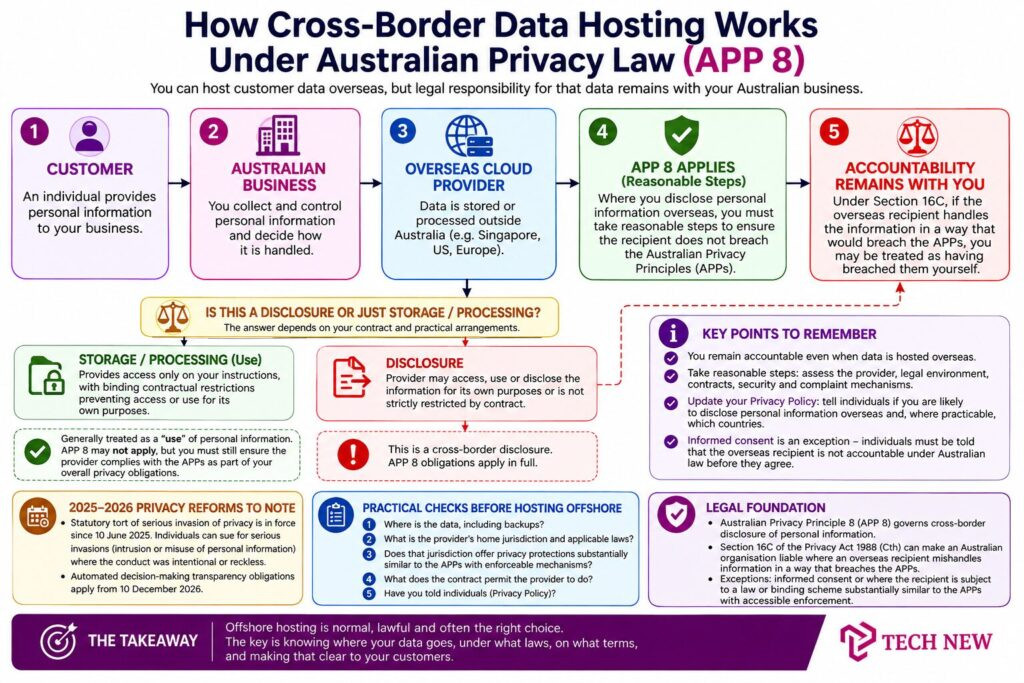
There are exceptions. The most relevant permits disclosure where you reasonably believe the recipient is subject to a law or binding scheme that has an effect substantially similar to the APPs, and where the individual can access mechanisms to enforce that protection. The other common exception is informed consent, which requires genuinely telling the individual that the overseas recipient will not be accountable under Australian law before they agree.
The Whitelist That Does Not Exist Yet
Reform introduced a mechanism for the government to prescribe countries whose laws provide substantially similar protection, which would let businesses transfer to those jurisdictions without assessing each case individually. That mechanism came into force in December 2024.
The catch is that no countries have actually been prescribed. As matters stood through the first half of 2026, the list remains empty, which means the original APP 8 obligations continue to apply in full. If you were waiting for a simplified regime before reviewing your arrangements, the wait is ongoing and the existing rules apply in the meantime.
A second tranche of privacy reforms is being progressed, and the Attorney General confirmed as much in early 2026, but no timetable for legislation has been announced.
Storage Is Not Always Disclosure
One nuance genuinely helps businesses here, and it is widely misunderstood.
Regulatory guidance has long recognised a distinction between disclosing personal information to an overseas recipient and merely using an overseas provider to store or process it while retaining effective control. Where the arrangement is genuinely the latter, with a binding contract preventing the provider from accessing or using the information for its own purposes, the transfer can be characterised as a use rather than a disclosure, which changes the APP 8 analysis considerably.
This depends entirely on the contract and the practical arrangements rather than on labelling. A provider whose terms permit it to mine your data, or which reserves broad rights over the content you store, is not offering that arrangement whatever the marketing says. Reading the terms is the whole exercise.
The Statutory Tort Changes the Risk Picture
Since 10 June 2025, Australia has had a statutory tort of serious invasion of privacy. Individuals can sue for intrusion upon seclusion or misuse of personal information where the invasion was intentional or reckless, they had a reasonable expectation of privacy, and the public interest favours their claim. Remedies include damages and injunctions.
This matters for hosting decisions because it operates alongside the regulator rather than through it. Previously, a privacy failure meant dealing with the Office of the Australian Information Commissioner. Now it can also mean a claim brought directly by an affected individual, with its own limitation periods and its own consequences.
Note also that the automated decision-making transparency provisions from the same reform package carry a grace period that ends on 10 December 2026. If your systems make automated decisions using personal information, that deadline is close.
Practical Checks Before Hosting Offshore
Five questions cover most of it.
Where is the data, including backups? Backups replicate, and they are the component most often sitting somewhere nobody has audited. Ask specifically rather than assuming they follow the primary storage.
What is the provider’s home jurisdiction, not just its data centre location? These are different questions. A provider headquartered in one country storing data in another may be subject to legal demands from both. Only one of those facts usually appears in the marketing material.
What legal regime applies at the destination? Jurisdictions with comprehensive, enforceable privacy law and accessible complaint mechanisms make the APP 8.2 analysis considerably easier than jurisdictions without. European providers operating under the GDPR are commonly regarded as strong candidates on this reasoning, since the framework is comprehensive and individuals have real enforcement avenues. Independent European hosts such as QDE, operating infrastructure in the Netherlands under EU law, sit in that category, and are frequently cheaper than the large platforms for equivalent resources.
What does the contract permit the provider to do? This determines whether you have a storage arrangement or a disclosure, which is the difference between two quite different compliance positions.
Have you told people? Your privacy policy is required to address whether you are likely to disclose personal information overseas and, where practicable, which countries. Many policies say something vague about international transfers and stop there.
Two Things Often Missed
Small businesses with annual turnover under three million dollars are currently exempt from most of the Privacy Act. That exemption is one of the reform proposals under active discussion, and businesses relying on it should treat it as temporary rather than permanent.
Separately, if you have European customers, the GDPR may apply to you directly regardless of where you are based or where you host. Australian obligations are not the only ones in play for a business selling internationally.
The Sensible Position
Offshore hosting is normal, lawful and often the better commercial choice. The mistake is not hosting overseas. It is hosting overseas without knowing where, under whose law, on what contract terms, and without having told your customers.
That is an afternoon of work and a short document. Given that individuals can now sue directly and the regulator has grown considerably more active, it is an afternoon that has become easier to justify.

Similar Posts
How do the AI translation earbuds work: A Breakdown of AI-Powered Speech Translation
Why Ethical Use of AI in Education Matters
Mexi’s Unblocked Games Explained: Why It Appears in Schools, and the Truth About this Web Page