
The Role of Data in Training Ethical and Accurate AI Systems

Artificial intelligence has gone from science fiction to reality in just a few decades as people, sometimes without realizing it, have adopted machine-learning systems into their daily lives and work routines. At the center of all AI systems is data. Data isn’t merely the fuel that powers algorithms; it’s also an essential component of AI systems’ ability to be accurate, fair, reliable, and ethical. Yet as AI becomes part of the fabric of the world, understanding what it means for our data to be integrated to achieve moral and accurate outcomes is no longer just a “nice” thing; it is a need.
Data as the Foundation of Artificial Intelligence
AI models are trained to recognize patterns, relationships, and behavior from data, not by being explicitly told what to do. Whether it’s image recognition, language translation, drug screening, or financial prediction, the quality and organization of training data are direct factors in achieving the best results. Good data helps models generalize, and insufficient data leads to unreliable or even harmful predictions.
Data is also cumulative in its impact. Minor errors, omissions, or biases can compound as models scale and are deployed across millions of users. This makes data governance one of the most critical responsibilities in modern AI development services, where organizations must balance innovation with accountability.
Data Quality and Accuracy in AI Systems
AI accuracy depends heavily on the relevance, comprehensiveness, and cleanliness of the training data. Mislabeling, stale data, or noisy inputs undermine model learning. When an AI model encounters contexts not well-represented during training, its results are unreliable.
To achieve this, accurate data needs to undergo strict validation. This might involve deduplication, correcting incorrectly labelled example,s and updating datasets to account for changes in the world. For instance, an AI system trained on medical information from a decade ago might not identify new treatment options or (as today’s example indicates) emerging health issues. Truthful data is not stagnant: it must grow with the world to remain true.
Bias in Data and Its Ethical Implications
Among the most significant ethical problems facing AI is that it learns from biased data. It’s not algorithms alone that are biased; often, it’s baked into the historical data on which an AI system is trained. Social injustices, cultural biases, and structural discrimination might all be present in datasets, leading AI to replicate or exacerbate them.
For example, systems for facial recognition trained mostly on pictures of members of specific demographic groups can perform very poorly on other groups. Similarly, if the algorithms used to train the model are based on historical recruitment data, they could favour candidates who look like past hires and exclude qualified talent from underrepresented backgrounds. Transparency in AI means recognizing that data represent human decisions and social structures, not some truth handed down from on high.
Representativeness and Fair Data Collection
If the goal is to train ethical AI systems, then the data should be representative of the populations and contexts in which the system will operate. This includes actively pursuing diversity in your data sources and not over-reliance on convenient or easy-to-access datasets. Representativeness is the concept by which the marginalization of certain groups can be avoided, ensuring that outcomes are fair across diverse demographics.
Additionally, obtaining representative data poses practical and ethical dilemmas. Ethical principles, including consent, transparency, and cultural sensitivity, should be applied at all stages of data collection. Ethical AI is not an excuse for intrusive or exploitative data practices, even for better performance.
The Role of Annotation and Human Judgment
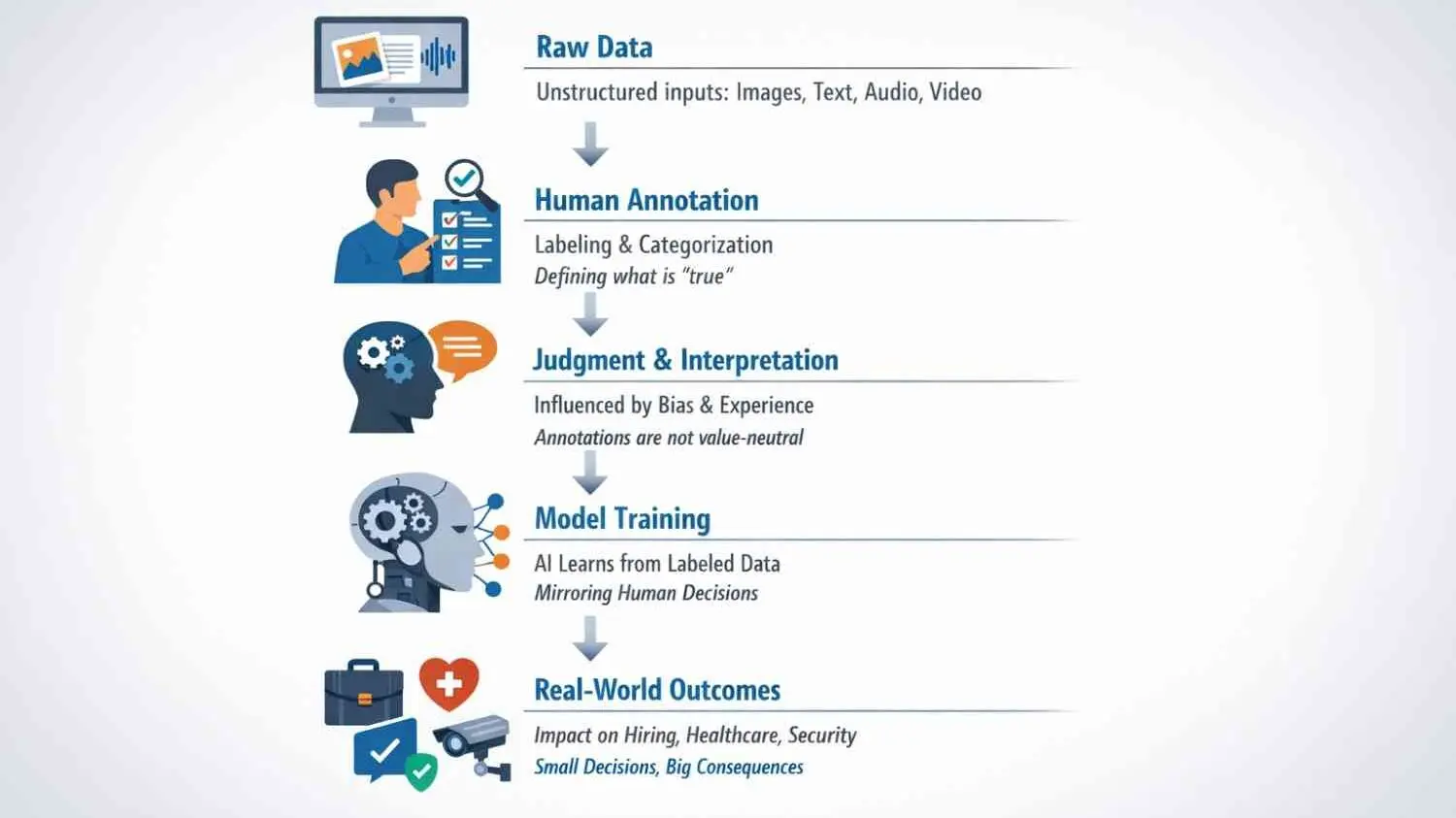
Data labeling is required for training AI, particularly for supervised learning models. Labelers categorize, and, in practice, arbitrators define what counts as true or false. These are the kinds of decisions that shape how AI systems see the world .
Annotation isn’t a value-neutral practice. The annotator’s viewpoints, prejudices, and restrictions are an intricate part of the process. Without clear mandates and accountability, mishaps can arise that distort learning. Ethical AI systems require clear annotation protocols, diverse annotation teams, and ongoing review to prevent subjective distortion.
Privacy, Consent, and Responsible Data Usage
There can be no ethical AI without individual privacy. Several AI systems depend on personal data, including browser history, location data, and biometric information. The irresponsible use of such data can result in surveillance, loss of freedom, and diminished public trust.
Responsible data use requires obtaining informed consent, anonymizing sensitive information, and not collecting more personal data than is necessary. With regulations such as those of UNESCO, ethical AI has been further strengthened, as it should be aligned with human rights. Data governance programs provide organisations with a way to openly manage these obligations.
Balancing Scale and Ethics in AI Training
Contemporary AI architectures typically achieve high performance only with large datasets. However, upscaling data acquisition introduces ethical hazards, including relaxed monitoring, increased bias, and a higher probability of privacy violations. Big data may be inherently dangerous, with disinformation and unknown sources galore that can affect model behaviour.
It’s a fine line between scale and ethics that requires careful curation. Quality cannot be compromised for quantity. With regular audits, dataset documentation, and impact assessments, large-scale datasets are more likely to conform to ethical standards than to resist them.
The Role of Transparency and Explainability
Responsible collection and use of data are intuitive ways to make ethical AI. The players need to know how data is collected, processed, and used in decision-making. This clarity is part of explainable AI and enables users to question decisions and flag potential slip-ups or biases.
Documentation, such as fact sheets and model cards, facilitates explaining the limitations of a dataset when used. Transparent AI systems based on data allow for ethical risks to be flagged and developers to be held accountable when things go wrong.
Data Lifecycle Management and Continuous Improvement
AI Ethics is not a point in time. Data needs to be governed throughout its existence, from inception and persistence through use and retirement. Ongoing monitoring detects performance drift, emerging bias or undesirable side effects as AI systems engage with the real world.
Feedback loops are essential for improvement. User feedback, real-world performance data, and independent evaluations can reveal gaps that were not apparent during initial training. In the middle of this process, organizations often rely on supporting capabilities such as seo copywriting services to communicate transparency, policies, and responsible AI commitments clearly to users and stakeholders.
Collaboration Between Technology and Society
AI requires the ethical use of data and collaboration beyond tech teams. Standards and expectations are shaped through the efforts of policymakers, ethicists, domain experts, and affected communities. Decisions about data use should be based on societal values, not just on computational convenience.
To do so, public engagement and interdisciplinary dialogue are essential so that these AI systems will address the common good rather than the interests of limited scope. By including multiple perspectives, organizations can better predict ethical issues and create systems that honor social norms and respect users’ human dignity.
The Future of Ethical and Data-Driven AI
Data will play an increasingly important role as AI technologies advance. Breakthroughs in synthetic data, federated learning, and privacy-preserving methods offer fresh potential to reduce ethical risk without sacrificing performance. The challenge of these techniques is to ensure minimal disclosure of sensitive material while still providing valuable learning.
Indeed, ethical and fair AI relies on the thoughtful use of data. Data is not just a feedstock; it is an expression of human values, choices, and responsibilities. Organizations that put fairness, accuracy, transparency, and accountability at the heart of how they handle data can create AI systems worthy of trust that deliver sustained value.
Similar Posts
How Australia’s Workplaces are being Transformed by Technology
Is Trello The Right Fit For Your Project Management Needs? Unbiased Review
Apple’s Gemini AI Deal in the Works? Alphabet Stocks React with 7% Surge