

BitChat Explained: How Jack Dorsey’s Offline Mesh App Works and Who It’s For in 2026
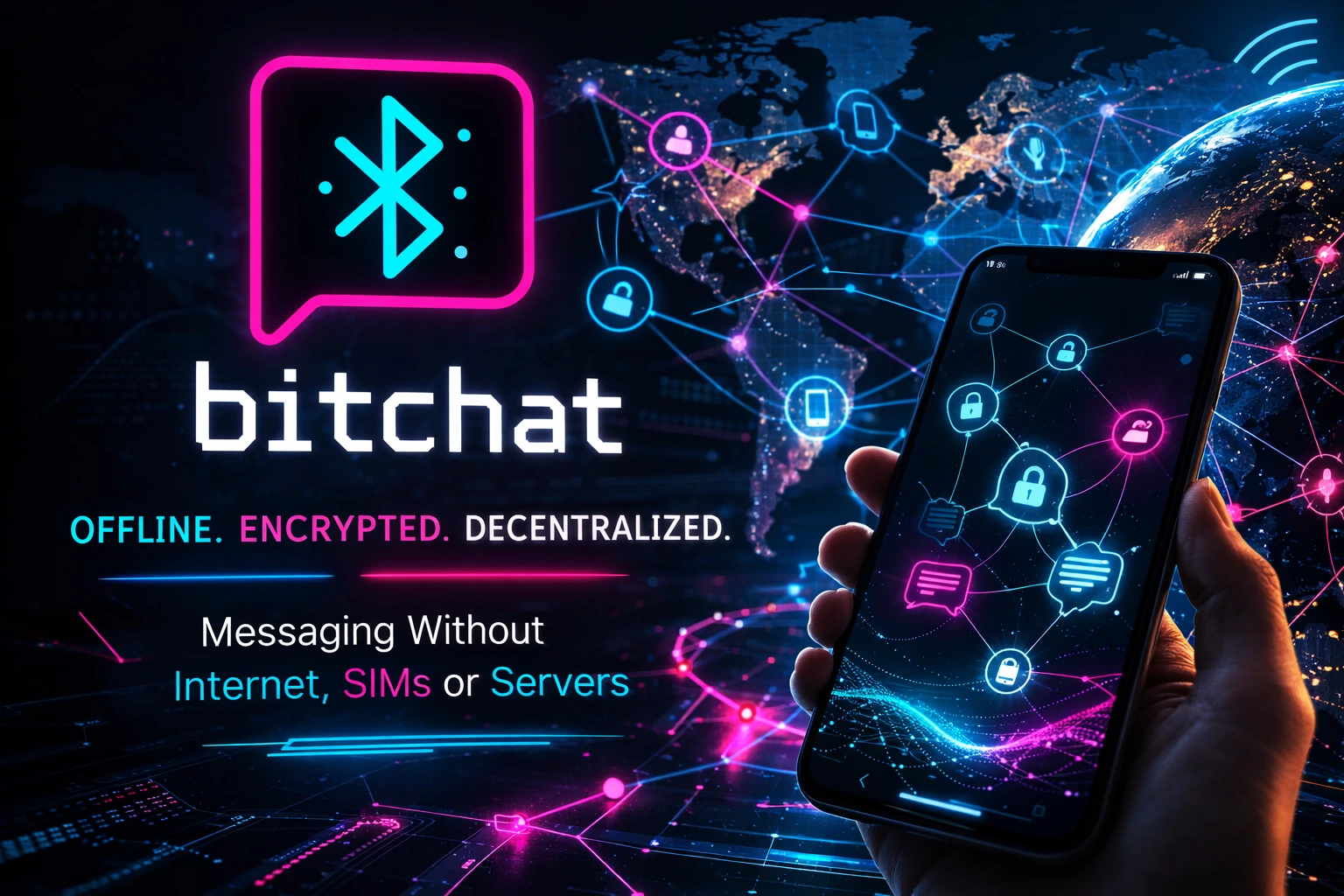
BitChat is a decentralized messaging app created by Jack Dorsey that works without internet, SIM cards, or cell towers. It uses Bluetooth mesh networking to send encrypted messages between nearby devices. This allows people to communicate locally during internet shutdowns or emergencies. However, it works best in crowded areas and does not replace nationwide networks.
Executive Overview
Jack Dorsey’s BitChat is designed to keep local communication alive when the internet, cell towers, or SIM cards aren’t available. It uses Bluetooth Low Energy (BLE) mesh networking so nearby phones can connect directly and relay encrypted messages across a crowd.
In 2026, BitChat sits at the intersection of three forces:
- Network disruptions and throttling in parts of the world
- Rising demand for privacy-preserving communication
- Stronger state-level monitoring capabilities
This article examines BitChat’s engineering realities, security posture, global relevance, and limits through an evidence-based, EEAT-aligned lens.
How BitChat Works (Engineering Reality, Not Hype)
1) Bluetooth Mesh Networking
BitChat relies on BLE, operating on the 2.4 GHz spectrum. Phones discover nearby peers and exchange encrypted packets. When multiple devices participate, messages “hop” device-to-device, extending reach.
- Typical BLE range: 10–100 meters indoors, potentially farther outdoors.
- Effective reach depends on user density and relay participation.
- No internet backbone is required for local delivery.
2) No Central Server by Default
Unlike traditional messaging apps, BitChat does not require:
- Cloud-hosted message routing
- Phone numbers
- SIM authentication
This reduces centralized metadata collection but shifts responsibility to device-level security.
3) Optional Hybrid Capability
In some builds or ecosystem integrations, decentralized internet protocols (e.g., Nostr-style relays) may extend reach when connectivity returns. That makes BitChat potentially hybrid: offline-first, internet-optional.
Security Architecture: What Experts Actually Assess
In 2026, “encrypted” is not enough. Serious analysis considers:
End-to-End Encryption (E2EE)
If implemented correctly:
- Only the sender and the recipient can read the content.
- Relays cannot decrypt message payloads.
However, security strength depends on:
- Cryptographic primitives used
- Key exchange implementation
- Independent audits
- Open-source transparency
Metadata & Radio Visibility
Even with E2EE:
- BLE broadcast density can be detected via spectrum monitoring.
- Traffic patterns may be observable.
- Physical device seizure remains a risk.
Encryption protects content. It does not eliminate RF-layer visibility.
Operational Security (OpSec)
For users in sensitive environments:
- Device encryption matters
- OS updates matter
- Screen locks matter
- App-level passcodes matter
Technology reduces risk, but user behavior still defines outcomes.
Can Governments Detect Bluetooth Mesh Networks?
Technically, yes.
Governments can deploy:
- Software-Defined Radios (SDRs) to monitor 2.4 GHz traffic
- RF spectrum analysis tools
- Traffic anomaly detection systems
Detection methods include:
- Identifying high-density BLE broadcasts
- Mapping unusual relay patterns
- Correlating device clustering
However, detection ≠ decryption. Encrypted payloads remain protected if cryptography is sound.
In highly regulated environments, authorities could also:
- Restrict Bluetooth APIs at the OS level
- Monitor large public gatherings for unusual RF patterns
- Legally regulate mesh tools under emergency frameworks
This is a technology-policy tension, not a one-sided advantage.
Can BitChat Scale Nationally?
Pure Bluetooth mesh is local by physics.
Limitations:
- Range constraints
- Dependence on user density
- Battery consumption
In dense urban environments, mesh can propagate effectively across large crowds.
Across rural areas or nationwide distances? Not realistically without hybrid internet relays.
BitChat is best understood as:
- A local resilience layer, not a cellular replacement.
- A bridge during outages, not a global internet substitute.
BitChat vs Bridgefy vs FireChat (2026 Comparison)
| Feature | BitChat | Bridgefy | FireChat |
| Core Tech | BLE mesh | BLE mesh | BLE + Wi-Fi P2P |
| Internet Required | No (local) | No (local) | No (local) |
| Encryption Model | E2EE (claimed) | Upgraded after early flaws | Early versions weak |
| Protest Adoption | Emerging | High (Hong Kong) | Early Iraq/HK |
| Security Maturity | Audit dependent | Improved over time | Historically weaker |
Key Insight:
Earlier mesh apps gained attention during protests but faced cryptographic scrutiny. Long-term credibility depends on transparent audits and security hardening.
Global Relevance in 2026
Over the past decade, internet shutdowns and throttling events have occurred in:
- Iran
- Myanmar
- Ethiopia
- Uganda
- Parts of India
- Conflict zones globally
Mesh networking appeals in such contexts because it:
- Removes dependency on centralized ISPs
- Operates during temporary blackouts
- Enables localized coordination
At the same time, governments have invested heavily in:
- AI-driven monitoring
- RF analysis tools
- Digital compliance laws
BitChat reflects a broader global shift:
Centralized infrastructure control vs decentralized communication resilience.
Who BitChat Is Actually For
1️⃣ Civil Society & Protest Movements
When mobile networks are restricted, mesh tools enable localized coordination.
2️⃣ Journalists & Field Operators
In unstable environments, local mesh communication reduces reliance on fragile networks.
3️⃣ Disaster Response Teams
After natural disasters, mesh networking can maintain short-range coordination when cellular networks fail.
4️⃣ Privacy-Focused Communities
Users who prefer minimal identity linkage may value decentralized messaging models.
5️⃣ Event & Campus Coordination
High-density environments are ideal for mesh relays.
Realistic Strengths vs Realistic Limits
Strengths
- Offline functionality
- Decentralized design
- Reduced centralized metadata
- Useful in dense environments
- Censorship-resistant at the infrastructure level
Limits
- Short-range physics
- Density-dependent scalability
- Detectable radio presence
- Battery trade-offs
- Security is dependent on audits
BitChat is powerful in specific contexts, not universally.
Expert Perspective: The 2026 Outlook
Mesh communication tools will likely:
- Improve cryptographic implementations
- Integrate hybrid satellite or internet relays
- Face stronger regulatory scrutiny
- The trigger arms race between decentralization and surveillance technologies
BitChat is part of a broader decentralization movement championed by Dorsey and others focused on open protocols and resilient infrastructure.
Its long-term relevance depends on:
- Security audits
- Adoption rates
- Regulatory responses
- Real-world testing under stress
Also Read: Best Educational Apps for Toddlers: Fun & Learning Combined
Final Assessment
BitChat is not a myth, nor is it magic.
It is:
- An engineering solution to infrastructure fragility
- Most effective in dense, local environments
- Resistant to centralized shutdowns
- Still visible at the radio layer
- Dependent on the user discipline and adoption
In 2026, its significance lies less in hype and more in what it represents: a shift toward communication systems that are harder to silence but not impossible to monitor.
FAQs
Does BitChat really work without the internet?
Yes. It uses Bluetooth mesh for local, encrypted messaging.
Is BitChat anonymous?
It can reduce identity linkage, but device-level security and RF detection still matter.
Can it be used during protests?
It can maintain local communication, especially in dense crowds.
Can governments block it?
They can monitor RF activity and regulate Bluetooth use, but encrypted content remains protected.
Is it safer than WhatsApp or Telegram?
It removes central server dependence but introduces different trade-offs. Security depends on implementation and audits.

Similar Posts
Hemingway Editor vs Grammarly (2025): Which AI Writing Tool Actually Improves Your Content?
30% Rule in AI | Don’t Rely 100% on AI Tools | Human Input Still Matters
Classroom 30x Tips & Tricks (2025): How to Play Safely, Boost Focus & Get the Best Game Experience