
Upscalix Revolution: How It Is Changing Global Mobile App Development

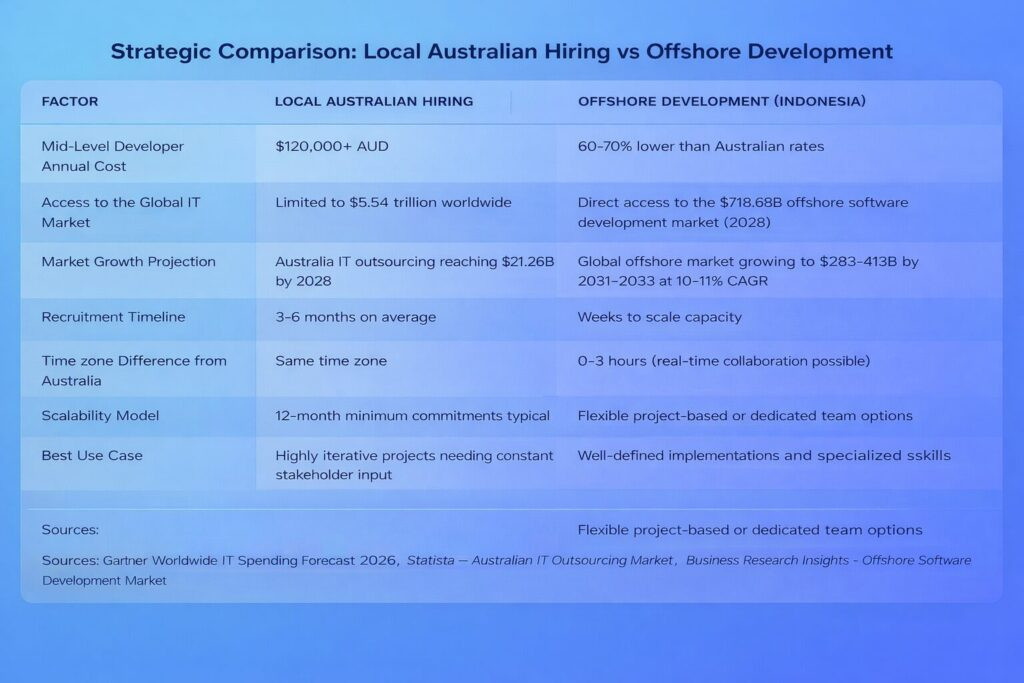
The numbers don’t lie. A mid-level software developer in Sydney pulls in over AUD 120,000 annually. Recruitment timelines? They vary significantly, often stretching longer than businesses can afford to wait, a reality pushing many organisations toward an outsourcing provider that can deliver talent on compressed schedules.
Australia is staring down a projected shortfall of 312,000 technology workers by 2030, according to the Australian Computer Society’s Digital Pulse report. For companies with ambitious digital roadmaps, particularly those requiring custom mobile app development, this gap represents more than an inconvenience; it’s a fundamental barrier to growth.
Yet businesses cannot hit pause on digital transformation.
This tension has cracked open an opportunity for a new breed of offshore software development company, one that isn’t promising the cheapest code but something the market increasingly values more: reliable delivery at scale without sacrificing communication standards.
Enter Upscalix, a Melbourne-headquartered IT outsourcing company that has built its business model on what might seem like a contradiction: that organizations don’t actually have to choose between local control and offshore economics.
But as with most things in offshore software development, the real challenge lies in execution.
The Trillion-Dollar Backdrop
Gartner Forecasts Worldwide IT Spending to Grow 10.8% in 2026, Totaling $6.15 Trillion. Australia’s slice of the IT outsourcing market alone is projected to reach US$21.26 billion by 2029.
This growth encompasses the broader BPO (business process outsourcing) ecosystem. Organizations increasingly seek to outsource IT services ranging from infrastructure management to custom application development.
The shift represents a fundamental recalculation in how businesses think about capacity.
The question isn’t whether offshore partnerships make sense anymore. Which IT outsourcing company can actually deliver strategic value beyond simple cost reduction?
The broader offshore software development market presents compelling figures, though numbers vary depending on which analyst you ask.
Industry projections suggest the sector will grow from approximately USD 178.6 billion in 2025 to USD 509.2 billion by 2035, an 11.04% compound annual growth rate. The driver isn’t merely cost reduction anymore.
Turns out, 65% of enterprises now cite scalability and access to specialized skills as primary motivations for hiring software developers through offshore arrangements.
Choosing the right IT outsourcing company has become a critical business decision, not just a procurement exercise. Selecting the wrong outsourcing provider can set projects back by months, burning through budgets whilst delivering little tangible value.
A Vision Beyond Cost Arbitrage
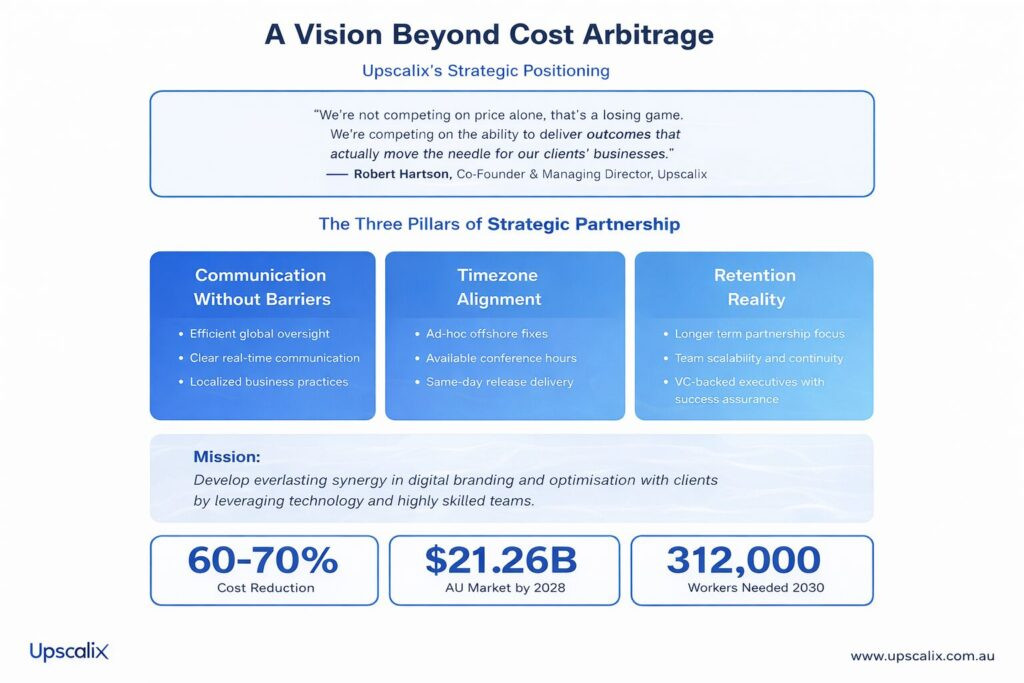
Traditional offshore outsourcing companies competed primarily on labor rates, essentially a race to the bottom.
Upscalix articulates a broader vision: to improve lives and organizations by releasing the power of innovative digital solutions that increase effectiveness, future growth, and profitability.
Whether that’s a genuine strategic orientation or clever marketing copy remains to be proven in practice.
The mission extends this further, fostering enduring synergy in digital branding and optimization with clients by leveraging technology and highly skilled teams, with an emphasis on quality, integrated systems, and reliability.
“We’re not competing on price alone; that’s a losing game,” says Roderich Hartono, co-founder and managing director of Upscalix. “We’re competing on the ability to deliver outcomes that actually move the needle for our clients’ businesses.“
For Australian businesses evaluating whether to hire software developers offshore, this philosophical shift matters practically. It signals, at least on paper, a partner willing to invest in understanding business outcomes rather than merely fulfilling technical specifications.
The Indonesian Talent Bridge
Upscalix connects Australian businesses with Indonesia’s tech talent pool, a deliberate geographic choice. Indonesia’s computer science education standards have risen dramatically, producing graduates whose technical capabilities rival those from established markets.
Yet compensation expectations remain 60-70% below Australian equivalents. That creates what appears to be a sustainable economic model for custom software development partnerships, assuming quality is not compromised by the arbitrage.
Here’s the thing: every offshore outsourcing company makes this claim. The proof is in execution.
- Communication without barriers
- Time zone alignment
- Retention reality
The Strategic Calculation
For enterprises evaluating whether to hire software developers offshore, several factors warrant consideration. Highly iterative projects requiring constant stakeholder input might benefit from local teams, whilst well-defined technical implementations could suit offshore execution.
Whilst reputable offshore outsourcing companies maintain IP protections, businesses with proprietary algorithms must carefully assess the associated risks. Once code leaves your direct control, you’re taking on risk.
An offshore development team that understands Australian business practices and aligns with organizational values will outperform a local team that lacks these qualities.
This is why Upscalix’s emphasis on English-proficient software developers and Australian time-zone collaboration represents more than convenience; it’s the structural enablement of partnership, assuming it works as advertised.
A relationship with an IT outsourcing company creates dependencies. Selecting financially precarious providers introduces unnecessary risk.
Established offshore software development companies with diversified client bases and demonstrated longevity offer greater security for custom software development projects with multi-year lifecycles.
Where This All Leads
As Australia’s digital economy continues to expand, demand for software development capacity will intensify, according to Deloitte Access Economics. Domestic talent supply cannot keep pace with this trajectory.
The offshore software development companies that thrive will transcend traditional vendor relationships. They’ll need to function as strategic partners capable of contributing genuine expertise, not merely execution capacity.
Upscalix’s model suggests one possible evolution. The company combines offshore economic efficiency with Australian governance whilst emphasizing quality over price competition.
By positioning as a trusted partner rather than a transactional vendor, they address concerns that have historically limited offshore adoption.
Whether they actually deliver on those promises over sustained periods, amid project challenges and competitive pressure, remains an open question.
The future belongs to organizations that can access world-class offshore developer talent whilst maintaining governance and cultural alignment of local teams.
This requires offshore outsourcing companies to deliver more than cost arbitrage; they must provide genuine partnership, operational transparency, and demonstrable commitment to client success.
For enterprises navigating digital transformation imperatives and talent scarcity, partnerships with specialized IT outsourcing companies are strategic necessities, provided they are structured intelligently.
The revolution, if there is one, isn’t in the offshore model itself. It’s in recognizing that businesses can hire software developers globally, whilst engineering hybrid delivery systems that make geography irrelevant.
This unlocks capacity that is impossible with purely local or purely remote approaches. The mobile app development market continues its trajectory towards USD 543 billion by 2030.
Companies that master this hybrid approach, combining offshore economics with local governance and global talent access with cultural alignment, should possess a decisive competitive advantage.
For Australian businesses evaluating whether to outsource IT services, the question has shifted. It’s no longer a question of whether relationships with offshore software development companies make strategic sense; talent scarcity has settled that debate.
The question is which partners demonstrate the maturity and capability to function as genuine extensions of internal teams.
Everything else is just cost arbitrage with extra steps and additional risk.
Upscalix:
Level 11/580 Collins St, Melbourne, VIC 3000, Australia
https://maps.app.goo.gl/oHFxXb5W26baQ7d47
Website: https://upscalix.com.au/
YouTube: https://www.youtube.com/@upscalix
FAQ
- How is Upscalix revolutionizing global mobile app development through its offshore model?
Upscalix connects Australian businesses with Indonesian developers at 60-70% lower costs while maintaining real-time collaboration and Australian governance standards. The company focuses on delivering business outcomes rather than competing on price alone.
- Why are Australian businesses turning to offshore software development?
Australia faces a projected shortfall of 312,000 technology workers by 2030, making local hiring increasingly difficult. Offshore partnerships provide access to skilled developers while reducing costs by 60-70% compared to local rates.
- Which projects suit offshore development best?
Well-defined technical implementations and projects requiring specialized skills work best with offshore teams. Highly iterative projects needing constant stakeholder input may benefit more from local developers.
Similar Posts
Fixed vs NBN: Which Internet is Better?
Australia’s Economic Challenges: Struggle with Rising Costs and Instability
Appointy Online Scheduling Software Unbiased Review