
Is PointClickcare a Reliable Cloud-Based EHR Software? Complete Review 2025
After reviewing PointClickCare closely, I see it as a powerful long-term care EHR that brings order to documentation, medication tracking, and compliance, but it also demands time, training, and strict workflows from you. It works best in nursing homes and assisted living facilities that are prepared to trade short-term convenience for long-term control and audit readiness.
This PointClickCare review shares what you actually experience when using the software, where it helps, where it frustrates staff, and who should or should not adopt it in 2025–2026.
What is PointClickCare used for in real facilities?
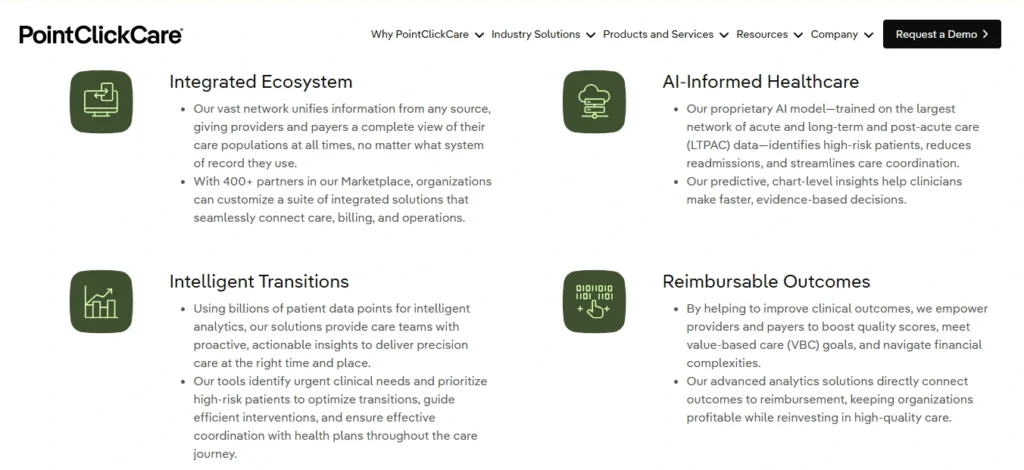
In practice, PointClickCare is used to run day-to-day operations in long-term and post-acute care, not just to store records.
You use it to:
- Document resident care every shift
- Track medication administration precisely
- Complete regulatory assessments that affect reimbursement
- Prepare for inspections and audits
- Coordinate care during admissions, discharges, and transfers
Once PointClickCare’s core features are fully adopted, the platform becomes a single source of truth. If something is not recorded in the system, it effectively did not happen.
Who actually uses PointClickCare software?
PointClickCare software is used almost exclusively by long-term care providers, not general hospitals.
That includes:
- Nursing homes and skilled nursing facilities
- Assisted living communities
- Memory care centers
- Post-acute rehabilitation facilities
- Home health and hospice providers
On the ground, nurses are the heaviest users. Administrators rely on it for compliance. Billing teams depend on it for reimbursement accuracy. Physicians usually interact with it more lightly, often reviewing rather than documenting.
This matters because the system is nurse- and compliance-driven, not physician-centered like hospital EHRs.
What it feels like in the first 30 days of PointClickCare Use
This is where most PointClickCare user experience reviews fail, so let’s be honest.
In the first month, it slows you down.
Documentation takes longer. Staff feel overwhelmed. People complain that “everything takes too many clicks.” New users often feel like they are serving the system instead of the residents.
This is normal.
The system forces you to document properly from day one. There is no easy way to skip steps without consequences. If your staff previously relied on informal notes or memory, that behavior gets exposed very quickly.
Facilities that abandon PointClickCare early usually do so in this phase.
What changes after 90 days of real use
By the three-month mark, something shifts.
Staff stop asking where information is. Shift handovers become clearer. Medication discrepancies drop. Administrators start trusting reports instead of double-checking everything manually.
You still hear complaints, but they change in tone. Instead of “this system is impossible,” it becomes “this part is annoying, but at least everything is there.”
This is when PointClickCare starts earning its place.
What it’s like after 6 months
At this stage, most facilities do not want to go back.
Audits feel less chaotic. Documentation gaps are easier to spot early. When something goes wrong, the system provides a clear trail of what happened, when, and who documented it.
PointClickCare does not reduce responsibility. It makes responsibility visible. That visibility is uncomfortable at first, but protective over time.
Is PointClickCare easy to use?
No. And any review that says it is easy is not being honest.
PointClickCare is learnable, not intuitive.
It is designed around regulatory and clinical requirements, not user comfort. Once trained, staff can work efficiently, but shortcuts are limited. This is deliberate. The system prioritizes consistency over flexibility.
If your facility invests in training, usability improves. If training is rushed, frustration compounds.
Medication management: where PointClickCare earns respect
Medication management is one area where PointClickCare consistently performs well.
Electronic medication administration records reduce ambiguity. You can see exactly what was given, when, and by whom. This protects residents and staff alike.
The trade-off is strict documentation discipline. Late entries, skipped steps, or informal practices do not work well here. For some teams, that feels restrictive. For others, it becomes a relief.
Clinical documentation and care planning in practice
PointClickCare’s clinical documentation is thorough, sometimes painfully so.
Care plans evolve as resident conditions change, and the system expects updates. This reduces “copy-paste care” but increases documentation workload.
Facilities that care about quality improvement benefit most. Facilities that view documentation as a checkbox struggle more.
What staff complain about (and why they’re not wrong)
Staff complaints are consistent across facilities:
- Too many screens
- Too many required fields
- Slow onboarding for new hires
- Internet dependency
- Not forgiving of mistakes
These complaints are valid. PointClickCare is not forgiving software. It assumes healthcare is high-risk work and treats documentation accordingly.
The upside is fewer grey areas. The downside is less flexibility.
What are the real disadvantages of PointClickCare?
The biggest disadvantages are not technical. They are cultural.
PointClickCare exposes weak processes. It exposes poor training. It exposes inconsistent care practices. Some organizations are not ready for that level of transparency.
Smaller facilities with limited staff may find the workload heavy. Facilities with high turnover struggle unless onboarding is structured.
Customization exists, but it is not instant. Changes often require planning and vendor involvement.
How much does PointClickCare cost, realistically?
PointClickCare pricing is not publicly listed, and that alone frustrates many buyers.
In reality, costs depend on:
- Number of residents
- Facility type
- Modules selected
- Training and implementation scope
For 2025–2026, you should treat PointClickCare as an enterprise investment, not a budget solution. The hidden cost is not licensing. It is staff time, training, and change management.
Facilities that underestimate this regret the decision.
Is PointClickCare HIPAA compliant?
Yes. PointClickCare is designed to support HIPAA compliance, including role-based access, audit logs, and secure data handling.
More importantly, it enforces behavior that supports compliance. You cannot rely on informal workarounds without creating risk.
Is PointClickCare better than Epic or Cerner?
This question comes up often, and it misses the point.
Epic and Cerner are built for hospitals and acute care. PointClickCare is built for long-term care realities. Comparing them directly is like comparing an airline cockpit to a long-haul truck dashboard.
If your environment involves extended stays, daily care documentation, and regulatory reporting, PointClickCare is usually the better fit.
Who should NOT choose PointClickCare?
You should seriously reconsider PointClickCare if:
- Your facility wants minimal documentation
- Staff resist structured workflows
- Training budgets are limited
- Internet reliability is poor
- Leadership expects immediate efficiency gains
PointClickCare rewards commitment. Half-adoption leads to frustration.
So, is PointClickCare worth it in 2025–2026?
If you are prepared to change how your facility documents, communicates, and accounts for care, PointClickCare is worth it.
If you want software that adapts to existing habits, it is not.
PointClickCare does not make care easier.
It makes care accountable.
For many long-term care providers, that accountability is exactly why they stay with it.
Also Read: Outlook with GoDaddy Review (2025): Is Microsoft 365 Email Hosting Worth It for You?
Final takeaway (real review stance)
After evaluating how PointClickCare functions in real environments, the conclusion is clear:
This software does not impress you quickly.
It earns trust slowly.
Facilities that commit to it often rely on it deeply. Facilities that expect convenience without structure usually walk away.
Your experience with PointClickCare will mirror your organization’s readiness for discipline.
FAQs
Does PointClickCare require staff training?
Yes, PointClickCare requires formal staff training for effective use. Without structured onboarding, most facilities experience documentation errors, workflow delays, and staff frustration during the early adoption phase.
Can PointClickCare be accessed remotely?
Yes, PointClickCare is a cloud-based platform and can be accessed remotely through a web browser. Access depends on user permissions and secure login credentials rather than physical location.
Does PointClickCare integrate with other healthcare systems?
PointClickCare integrates with hospitals, pharmacies, laboratories, and other healthcare systems to support care coordination. Integration capabilities vary depending on the facility’s setup and selected modules.
Can PointClickCare handle multiple facilities under one organization?
Yes, PointClickCare can support multi-facility organizations. Administrators can manage data across multiple locations while maintaining separate records and permissions for each facility.
Is PointClickCare suitable for home health and hospice care?
PointClickCare is suitable for home health and hospice providers, particularly those that require structured documentation, compliance tracking, and coordination across care teams.
What happens if the internet goes down while using PointClickCare?
If internet connectivity is lost, access to PointClickCare is temporarily unavailable because it is a cloud-based system. Facilities typically rely on contingency documentation procedures until access is restored.
Does PointClickCare offer reporting and analytics?
Yes, PointClickCare provides reporting and analytics tools that help facilities monitor clinical performance, compliance metrics, and operational trends over time.
Can PointClickCare be customized to fit facility workflows?
PointClickCare allows limited customization, but most workflows follow standardized structures. Significant customization usually requires configuration support and planning rather than quick changes.
How long does it take to implement PointClickCare?
Implementation time varies by facility size and complexity, but full adoption often takes several weeks to a few months, including setup, training, and workflow adjustment.
Does PointClickCare have a mobile app?
PointClickCare offers mobile-access options for certain functions, but most advanced documentation and administrative tasks are performed through the web-based platform.
Similar Posts
Easy Ways to Fix Error 16 Quickly
TikTok Music Clash with Universal Music Group Forces Removal of Popular Songs
How Investors Are Using 5StarStocks to Spot Hidden Gems