
How Lotus Health Built a Free AI Doctor and Raised $41M Without Insurance
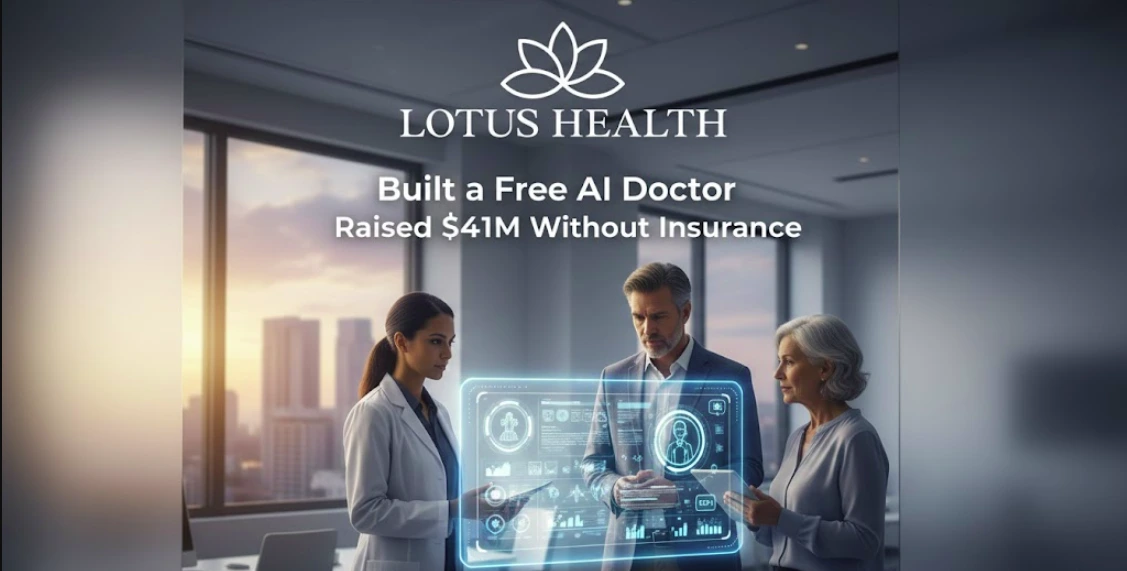
Healthcare has experimented with AI for years, yet most tools never moved beyond advice or basic triage. Costs kept rising, insurance remained complex, and doctors continued to drown in administrative work.
Lotus AI doctors represent a different approach.
Lotus Health operates as a real medical practice where AI systems support licensed physicians in diagnosing conditions, prescribing medication, and referring patients to specialists. Care is free for patients, available around the clock, works across languages, and does not require insurance.
This model has drawn $41 million in funding from leading venture firms, including Kleiner Perkins and CRV, alongside individual backers connected to OpenAI, Microsoft, Harvard, and Stanford.
The key question is not whether this sounds ambitious.
It is whether the system is designed to work at scale.
What Are Lotus AI Doctors?
Lotus AI doctors are AI-assisted clinical systems used by licensed physicians to deliver real medical care. The AI supports intake, medical record analysis, and evidence checks, while human doctors remain legally responsible for diagnoses, prescriptions, and referrals.
This distinction matters.
Unlike chatbots or symptom checkers, Lotus AI doctors are embedded in a regulated care environment. AI accelerates workflow, but accountability stays with licensed professionals.
How Lotus AI Doctors Work in Practice
The system is designed around workflow efficiency rather than automation for its own sake.
The AI collects symptoms, medical history, and prior records, organizing fragmented data into a single clinical view. It cross-checks current medical guidelines and recent research to assist decision-making.
Doctors review findings, approve prescriptions, and manage referrals. The AI does not act independently. It functions as infrastructure.
Digital health researchers have consistently argued that this model is the safest path forward. Eric Topol has long emphasized that AI delivers the most value when it reduces clinician burden rather than replacing medical judgment. These AI doctors follow that principle closely.
Why Lotus AI Doctors Can Deliver Care Without Insurance
Insurance is one of the largest contributors to healthcare costs. Claims processing, billing codes, reimbursement delays, and compliance requirements add layers of overhead that patients rarely see but always pay for.
It removes insurance entirely from the care loop.
By using AI to automate documentation, intake, and evidence checks, the platform reduces operational cost per patient. Without insurance billing, it avoids claims processing, coding disputes, and administrative staffing tied to reimbursement systems.
This simplified structure makes free-to-patient care economically viable.
The Business Model Behind Lotus AI Doctors
Lotus Health does not charge patients or insurers. Instead, it uses a premium sponsorship model to fund operations.
Sponsorships support the platform but are structurally separated from clinical decisions. Doctors retain authority over care, and treatment is not influenced by sponsors.
From a business perspective, this resembles how infrastructure platforms scale: minimize friction, expand access, and monetize through partnerships rather than per-use fees.
Investors increasingly favor healthcare models that decouple access from insurance complexity while maintaining regulatory discipline.
How AI Makes Doctors More Productive Without Replacing Them
Lotus claims its system can make doctors significantly more productive. This does not mean faster or lower-quality care.
Productivity gains come from:
- Automated documentation
- Structured patient histories
- Faster access to evidence
- Reduced administrative time
AI industry leaders consistently frame this as augmentation, not replacement. Jensen Huang has repeatedly described AI’s role as amplifying professional capacity rather than automating responsibility.
In healthcare, that distinction is essential.
Why Investors Backed Lotus AI Doctors With $41M
Healthcare startups face strict regulation, long sales cycles, and high trust requirements. Funding at this level signals confidence in the underlying system.
Investors such as Kleiner Perkins and CRV typically look for:
- Regulatory awareness
- Scalable economics
- Defensible workflows
They meet those criteria by keeping licensed physicians accountable, using AI to reduce cost rather than bypassing rules, and designing a model that scales without insurance dependency.
For investors, this is a bet on system redesign, not speculative AI.
How Lotus AI Doctors Compare to Other AI Healthcare Platforms
| Platform type | What it offers | Key limitation |
| Symptom checkers | Information | No treatment |
| Telehealth apps | Video visits | Cost and availability |
| AI chatbots | Advice | No prescriptions |
| Lotus AI doctors | AI-assisted medical care | Requires strict oversight |
They occupy a middle ground: faster than traditional care, but still accountable.
Risks, Limits, and Regulatory Reality
No healthcare innovation is risk-free.
Key challenges include:
- Maintaining physician oversight at scale
- Navigating regional regulations
- Protecting patient data
- Ensuring sponsorships never influence care
Even experts supportive of clinical AI continue to warn against over-automation. Public health leaders such as Atul Gawande have long argued that healthcare innovation must strengthen systems, not weaken accountability. Lotus AI doctors depend on enforcing that boundary as the platform grows.
What Lotus AI Doctors Signal for Healthcare in 2026
Lotus AI doctors reflect a broader shift in health technology. AI is moving away from advice and toward infrastructure. The focus is not intelligence for its own sake, but efficiency, access, and workflow design.
If the model holds, it suggests a future where healthcare becomes less dependent on insurance complexity and more focused on clinician-led care supported by automation.
Also Read: Types of AI in Healthcare and How They Transform Medicine
Key Takeaways
- Lotus AI doctors operate within a real medical practice
- AI supports doctors rather than replacing them
- Care is free by removing insurance from the system
- Sponsorships fund operations, not clinical decisions
- $41M in funding reflects confidence in the model’s structure
FAQs
Can Lotus AI doctors prescribe medication?
Yes. Prescriptions are issued by licensed physicians after reviewing AI-assisted clinical assessments, making them legally valid.
Is care from Lotus AI doctors free?
Yes. Care is free for patients because Lotus Health removes insurance billing and funds operations through a sponsorship-based business model.
How are Lotus AI doctors different from ChatGPT or symptom checkers?
Lotus AI doctors deliver real medical care with doctor oversight, while chatbots and symptom checkers only provide information or advice without prescriptions or referrals.
Is using Lotus AI for doctors safe?
Safety depends on maintaining strict physician oversight, regulatory compliance, and data protection. Lotus Health’s model keeps doctors accountable for all clinical decisions.
Do Lotus AI doctors replace human doctors?
No. The system is designed to support and augment doctors, not replace them, by reducing administrative work and improving workflow efficiency.
Similar Posts
The Best Wifi Mesh for 2024
Modern First Aid In Thomastown: Where Technology Meets Emergency Care
Will Optimus AI Robots Replace Surgeons? Elon Musk’s Claim vs Medical Reality