
Australia’s Biggest Online Marketplaces in 2026: Traffic, Market Share, Buyer & Seller Analysis

Australia’s e-commerce market is now worth more than AUD $69 billion annually, and marketplaces account for a large share of that spending. In 2026, online marketplaces are not just shopping websites. They are full retail ecosystems that shape pricing, delivery standards, and seller competition across the country.
This analysis examines:
- The largest online marketplaces in Australia
- Traffic scale and market share positioning
- Category strength by platform
- Buyer comparison across major marketplaces
- Seller fees and margin structure
- Growth trends from 2019 to 2026
The goal is clear: understand the real marketplace landscape, not just a list of names.
2026 Australia’s Biggest Online Marketplace Ranking Overview (Completed Table)
| Rank | Marketplace | Est. Monthly Visits | Est. Annual Sales | Category Breadth | Seller Model | Key Strength |
| 1 | Amazon Australia | 70–80M | $12–15B | Very broad (30+ categories) | Marketplace + FBA | Logistics & scale |
| 2 | eBay Australia | 30–40M | $8–10B | Broad + resale | Marketplace | Auctions & used goods |
| 3 | Temu | 25–35M | $2.6B+ | General goods | Cross-border supplier | Ultra-low pricing |
| 4 | Facebook Marketplace | 17M+ users (app reach) | High P2P volume | Resale & local | Peer-to-peer | Zero listing fees |
| 5 | Shein | 10–15M | ~$1B+ | Fashion | Direct retail | Low-cost apparel |
| 6 | Kogan | 10–15M | $600–800M | Electronics + home | Hybrid | Budget pricing |
| 7 | The Iconic | 8–12M | Strong fashion volume | Fashion | Retail + brands | Premium fashion |
| 8 | MyDeal | 5–8M | Home-focused | Furniture & home | Marketplace | Bulky goods |
| 9 | Woolworths Online | High grocery traffic | Multi-billion grocery | Groceries | Retail + partners | Supermarket dominance |
| 10 | Coles Online | High grocery traffic | Multi-billion grocery | Groceries | Retail | Essential goods |
| 11 | Big W | High retail traffic | Multi-category retail | General goods | Retail | Everyday pricing |
| 12 | Kmart | High retail traffic | Multi-category retail | Essentials | Retail | Low-cost household |
| 13 | JB Hi-Fi Online | Strong electronics traffic | Electronics-heavy | Tech & appliances | Retail | Tech leadership |
| 14 | Bunnings Online | Strong hardware traffic | Home improvement | Hardware | Retail | DIY & trade focus |
| 15 | Gumtree | High classifieds traffic | P2P volume | Resale | Classifieds | Local marketplace |
| 16 | Grays | Niche auction traffic | Industrial & surplus | Auctions | Auction model | Surplus goods |
| 17 | Ozsale | Fashion & deals traffic | Flash sales | Fashion deals | Retail | Discount fashion |
| 18 | Fishpond | Books & general | Cross-category | Books/media | Retail | Long-tail catalog |
| 19 | Trade Me (AU presence) | Limited AU traffic | Auction volume | Auctions | Marketplace | Cross-border niche |
Now we examine the major platforms in detail.
1. Amazon Australia
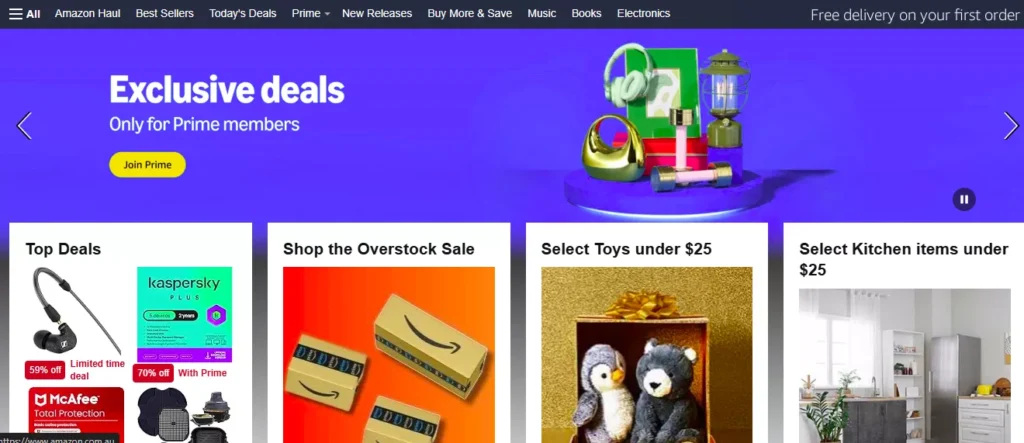
Market Scale
- Estimated monthly visits: 70–80 million
- Estimated annual marketplace sales: $12–15 billion
- Estimated Prime members: 3–4 million
- Category coverage: 30+ categories
Amazon is the largest online marketplace in Australia by traffic and transaction volume.
Category Strength
Amazon dominates:
- Electronics
- Home goods
- Beauty
- Books
- Small appliances
- Everyday essentials
It has expanded grocery and pantry categories steadily.
Buyer Experience
Strengths:
- Fast delivery (often 1–3 days in metro areas)
- Structured return process
- Wide product selection
- Consistent interface
Drawbacks:
- Price is not always the lowest
- Marketplace sellers vary in quality
- Counterfeit risk in some categories
Seller Model
Amazon supports third-party sellers through:
- Referral fee structure (typically 6–15%)
- Optional Fulfilled by Amazon (FBA)
- Advertising tools within the platform
Typical cost structure:
- Referral fee: ~10–15%
- FBA fulfilment fee: variable by size/weight
- Storage fees for warehousing
Benefits for sellers:
- National reach
- Logistics handled via FBA
- High buyer trust
Drawbacks for sellers:
- High competition
- Margin pressure
- Dependence on Amazon’s policies
- Ranking algorithm influence
Competitive Position
Amazon leads the Australian marketplace sector due to infrastructure scale, not just brand recognition.
2. eBay Australia
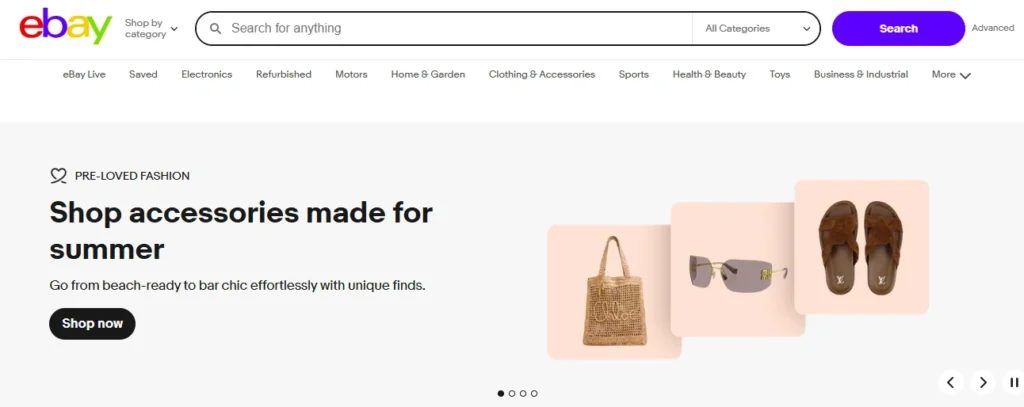
Market Scale
- Estimated monthly visits: 30–40 million
- Estimated annual sales: $8–10 billion
- Operating since 1999 in Australia
Category Strength
eBay performs strongly in:
- Automotive parts
- Refurbished electronics
- Collectibles
- Used goods
- Auctions
It remains the strongest resale-focused structured marketplace.
Buyer Experience
Strengths:
- Wide variety of sellers
- Competitive pricing in used categories
- Auction model for deals
Drawbacks:
- Delivery times vary by seller
- Return policies differ
- Less centralized fulfilment than Amazon
Seller Model
Fee structure:
- Final value fee typically 10–14%
- Listing is generally free up to limits
Benefits:
- Flexible pricing
- Strong automotive segment
- Lower entry barrier than Amazon
Drawbacks:
- Self-managed shipping
- Less integrated logistics
- Intense price competition
Competitive Position
eBay remains highly relevant in the resale and automotive sectors, even as Amazon leads overall volume.
3. Temu
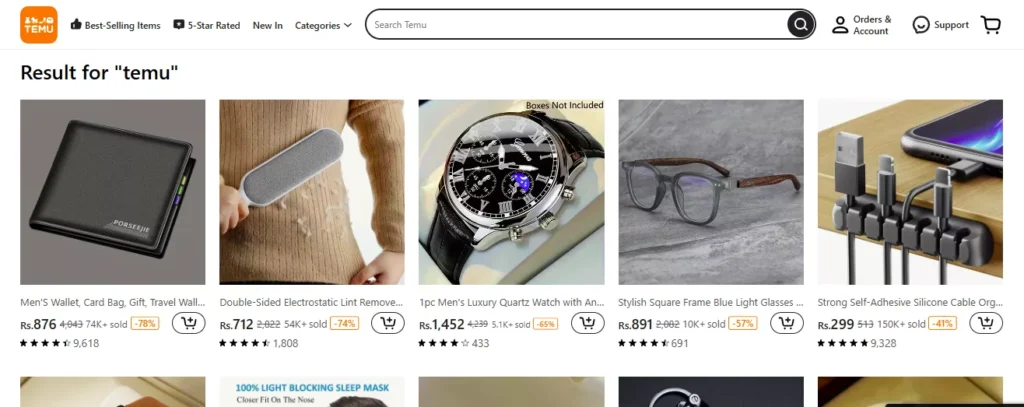
Market Scale
- Estimated Australian buyers: 4–5 million
- Estimated annual sales exceeding $2.6 billion
- Rapid growth over the past two years
Category Strength
Temu is strongest in:
- Low-cost household items
- Accessories
- Entry-level electronics
- Budget fashion
Buyer Experience
Strengths:
- Very low pricing
- Large product selection
- Promotional incentives
Drawbacks:
- Longer delivery times
- Variable product quality
- Cross-border shipping issues
Seller Model
Temu operates mainly on a cross-border supplier model.
For suppliers:
- Platform-controlled pricing influence
- Volume-driven model
Benefits:
- Access to a global buyer base
- Low operating complexity for cross-border sellers
Drawbacks:
- Thin margins
- Heavy reliance on volume
- Pricing pressure
Competitive Position
Temu is the fastest-growing marketplace in Australia, competing primarily on price rather than logistics speed.
4. Facebook Marketplace
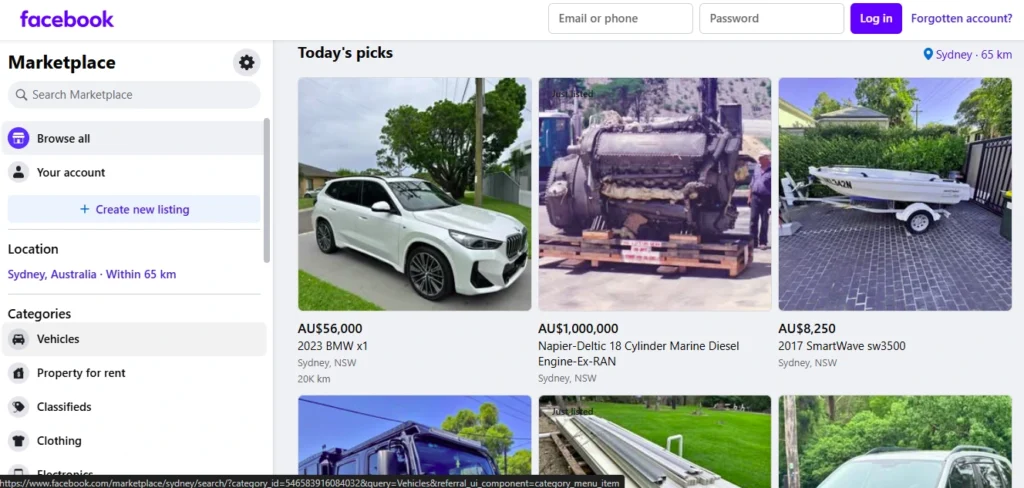
Market Scale
- Over 17 million Facebook users in Australia
- Large peer-to-peer transaction volume
Category Strength
Dominates:
- Used furniture
- Vehicles
- Local electronics
- Household goods
Buyer Experience
Strengths:
- No middleman in local deals
- Negotiable pricing
- Community-based selling
Drawbacks:
- No formal buyer protection in many cases
- Risk of scams
- No centralized shipping
Seller Model
- No listing fees for most local transactions
- Direct communication between buyer and seller
Benefits:
- Zero commission
- Immediate local reach
Drawbacks:
- No structured payment system (in many cases)
- Limited logistics support
Competitive Position
Facebook Marketplace is the largest informal resale ecosystem in Australia.
5. Shein
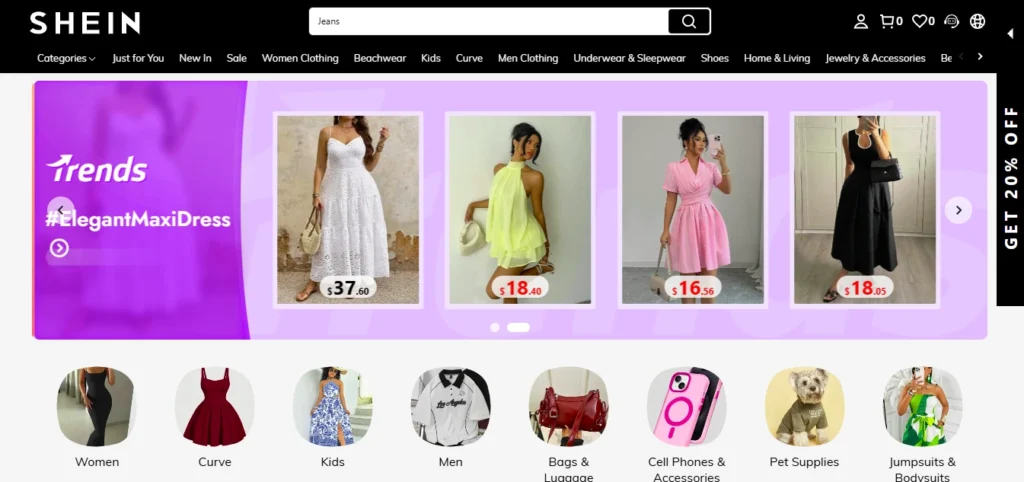
Market Scale
- An estimated 2.5–3 million Australian customers
- Strong traffic in the fashion segment
Category Strength
- Fast fashion
- Budget clothing
- Accessories
Buyer Experience
Strengths:
- Low prices
- Trend-focused catalogue
Drawbacks:
- Delivery delays
- Return complexity
- Sustainability concerns
Seller Model
Primarily operates as a direct retailer rather than open marketplace.
Competitive pressure is focused on pricing.
6. Kogan.com
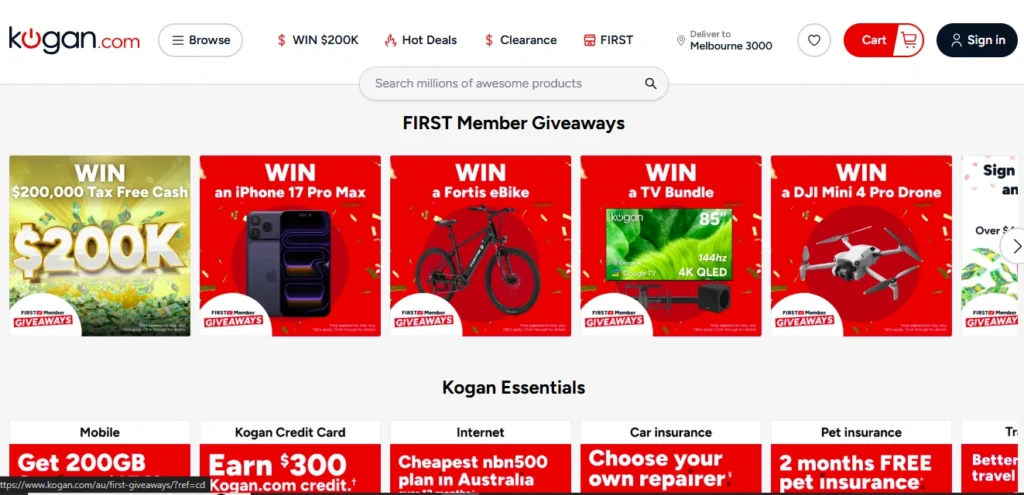
Market Scale
- Estimated annual revenue: $600–800 million
- Strong domestic brand recognition
Category Strength
- Electronics
- Appliances
- Private-label goods
Buyer Experience
Strengths:
- Competitive pricing
- Domestic brand trust
Drawbacks:
- Smaller range than Amazon
- Delivery speeds vary
Seller Model
Hybrid model with marketplace sellers.
The commission typically ranges around 10–15%.
Competitive Position
Kogan remains one of the largest Australian-owned ecommerce platforms but operates at a smaller scale than global competitors.
7. The Iconic
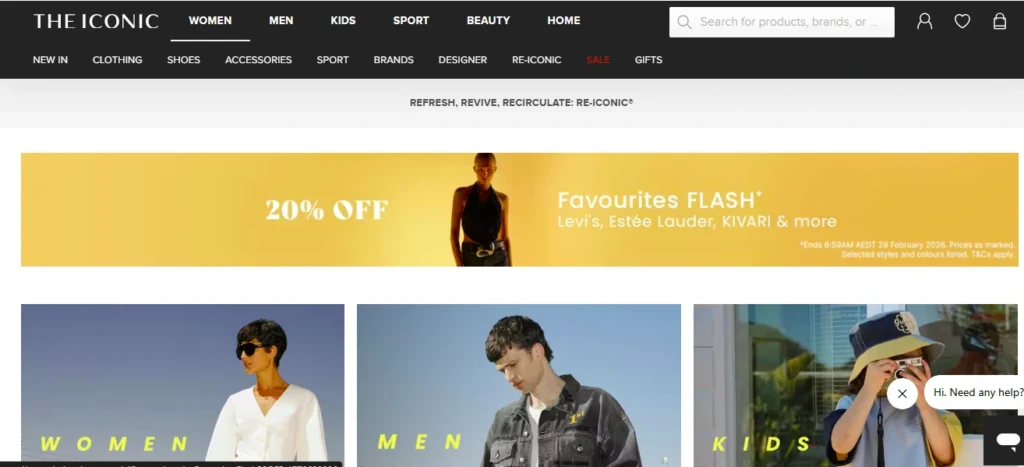
Market Scale
- Strong fashion traffic
- Premium brand positioning
Category Strength
- Branded apparel
- Footwear
- Accessories
Buyer Experience
Strengths:
- Fast shipping
- Strong return policy
- Recognised brands
Drawbacks:
- Higher pricing than discount platforms
8. Catch.com.au

Market Scale
- Discount-focused marketplace
- Mid-tier traffic volume
Category Strength
- General merchandise
- Flash sales
Buyer Experience
Strengths:
- Promotional pricing
- Deal-driven shopping
Drawbacks:
- Smaller inventory breadth
- High competition from Amazon and Temu
Also Read: 5 Ways AI in Australian Retail is Creating Smarter Customer Experiences
Australia E-commerce Growth: 2019–2026
| Year | Online Spend (AUD) | Growth Context |
| 2019 | $32B | Pre-pandemic baseline |
| 2020 | $50B | Surge period |
| 2022 | $62B | Stabilisation |
| 2024 | $69B | Steady growth |
| 2026 | ~$75B+ | Expansion phase |
Online penetration now accounts for nearly 18–20% of total retail spending.
This growth has strengthened marketplace dominance.
Category Share Across Online Marketplaces
| Category | Share of Online Sales | Leading Platforms |
| Fashion | 22–25% | Shein, The Iconic, Amazon |
| Electronics | 18–20% | Amazon, JB Hi-Fi |
| Home & Furniture | 15–18% | Amazon, MyDeal |
| Groceries | 12–15% | Woolworths, Coles |
| Beauty | 8–10% | Amazon |
| Automotive | 5–8% | eBay |
Amazon remains the most diversified marketplace by category coverage.
Buyer Comparison: Platform Strength by Experience
| Platform | Price Level | Delivery Speed | Category Breadth |
| Amazon | Medium | Fast | Very broad |
| Temu | Very low | Slower | Broad |
| eBay | Variable | Medium | Broad |
| Shein | Low | Medium | Fashion |
| Facebook Marketplace | Negotiated | Local pickup | Resale |
Buying behaviour in 2026 shows strong price sensitivity, but delivery reliability remains critical.
Seller Fee Comparison (2026)
| Platform | Commission Range | Fulfilment Model |
| Amazon | 6–15% | FBA or self |
| eBay | 10–14% | Self |
| Temu | Supplier-based | Platform |
| Kogan | 10–15% | Self |
| Facebook Marketplace | 0% local | Self |
Fee structure influences profit margins heavily.
Marketplace Growth Direction
From 2019 to 2026:
- Amazon strengthened through logistics expansion
- Temu captured price-sensitive segments
- eBay maintained resale dominance
- Local-only marketplaces faced stronger competition
Global platforms are increasing their share of total online retail spend.
Final Positioning of the Australian Marketplace Landscape
In 2026:
- Amazon Australia remains the largest online marketplace
- eBay remains highly relevant in resale and motors
- Temu continues rapid expansion
- Facebook Marketplace dominates informal resale
- Shein leads low-cost fashion
- Kogan competes in electronics
The marketplace ecosystem is not controlled by one model. It is shaped by logistics, pricing strategy, and category focus.
This complete view of traffic, category, buyer experience, seller cost, and growth data reflects the real online marketplace structure in Australia.
FAQs
1. What is the biggest online marketplace in Australia?
In 2026, Amazon Australia is the largest online marketplace in Australia. It receives an estimated 70–80 million monthly visits and generates approximately $12–15 billion in annual sales. Its nationwide fulfilment centres and Prime delivery service give it the largest market share in Australian ecommerce.
2. Which online marketplace is most popular in Australia?
Amazon Australia is currently the most popular e-commerce marketplace by traffic and sales volume. However, eBay Australia remains highly popular for resale and automotive parts, while Facebook Marketplace dominates local peer-to-peer transactions across major cities.
3. Is eBay or Amazon bigger in Australia?
Amazon is larger than eBay in Australia in terms of total sales volume and logistics infrastructure. Amazon’s annual marketplace sales are estimated between $12–15 billion, compared to eBay’s $8–10 billion. However, eBay remains stronger in used goods and automotive categories.
4. What is the fastest-growing online marketplace in Australia?
Temu is considered the fastest-growing online marketplace in Australia. It has rapidly expanded its customer base with aggressive pricing and cross-border supply chains, reaching millions of Australian buyers within a short period.
5. What is the best marketplace to sell on in Australia?
The best marketplace to sell on depends on product type and margins. Amazon offers a large reach and fulfillment support, but charges referral and fulfillment fees. eBay provides flexibility and lower entry barriers. Facebook Marketplace is a good fit for local resale with no commission fees.
Similar Posts
How to Fix Smart Square HMH Login Issues Quickly
Inside Noise-Cancelling Technology: What Makes Soundcore’s Earbuds and Headphones Stand Out?
Remotec 1279041 Universal Remote Codes