

Global Technology Trends Shaping the Next Decade
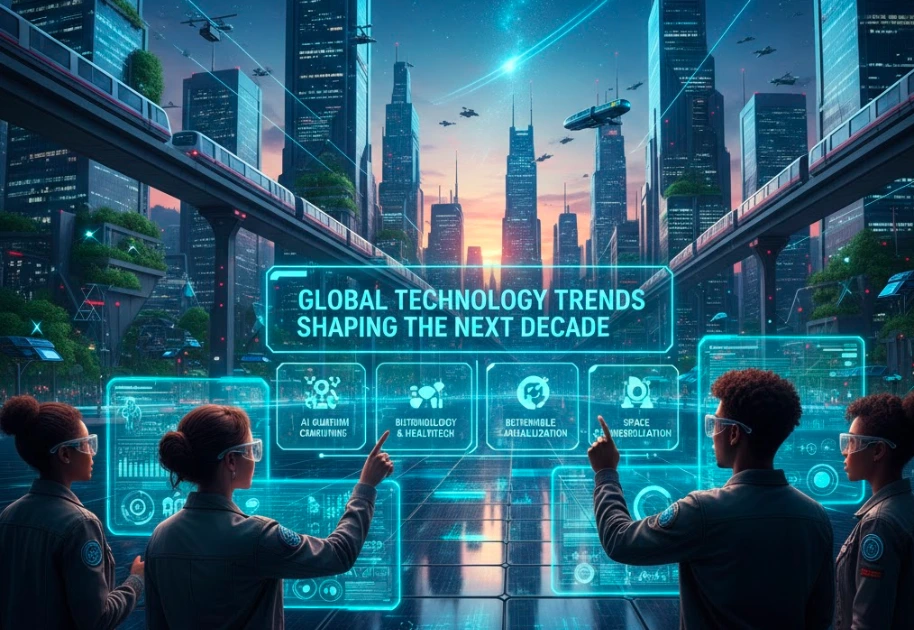
The next decade of technology will not be shaped by innovation alone, but by scale, adoption speed, and measurable economic impact.
Verified data from global research institutions shows that artificial intelligence, automation, cloud computing, cybersecurity, and sustainability are already reshaping how the world functions.
Below is a data-driven breakdown of the trends that will define the coming decade.
1. Artificial Intelligence Becomes Economic Infrastructure
Artificial intelligence is transitioning from experimental technology to core economic infrastructure.
According to McKinsey Global Institute, AI could add up to $13 trillion to the global economy by 2030, increasing global GDP by roughly 1.2% annually. This growth is driven not by consumer tools, but by enterprise-level automation and decision intelligence.
Research from PwC further estimates that 70% of the global economic impact of AI will come from productivity gains, not job replacement. This reinforces the shift toward AI as a supporting system rather than a standalone product.
Organizations building large-scale AI ecosystems, including OpenAI and Google, are accelerating this transition by embedding AI directly into workflows, analytics, and infrastructure.
Why this matters:
AI adoption is no longer optional. It is becoming a baseline requirement for competitiveness.
2. Automation Will Reshape, Not Erase, Jobs
Automation is often framed as a threat to employment, but data shows a more complex reality.
The World Economic Forum (Future of Jobs Report) projects that by 2030, automation and AI will displace 85 million roles globally, while creating 97 million new roles, resulting in a net gain of 12 million jobs.
Additionally:
- Over 50% of global employees will require reskilling by 2030
- Demand for analytical, technological, and human-centric skills will grow fastest
Companies investing in robotics and automation, including Tesla, are focusing on augmenting human labor rather than fully replacing it.
Why this matters:
The next decade rewards adaptability and skill evolution, not job elimination.
3. Cloud and Edge Computing Dominate Digital Growth
Cloud computing is now the backbone of the digital economy.
According to Gartner, global end-user spending on public cloud services is projected to exceed $1 trillion annually by 2027, up from approximately $600 billion in 2023.
Meanwhile, IDC reports that 75% of enterprise data will be processed at the edge by 2025, driven by:
- IoT expansion
- Real-time analytics
- Autonomous systems
Major cloud platforms such as Amazon Web Services and Microsoft Azure are shifting toward hybrid and edge-enabled architectures.
Why this matters:
Computing power is becoming decentralized, invisible, and continuously available.
4. Cybersecurity Costs Reach Trillion-Dollar Scale
Cybersecurity threats are growing faster than defensive capabilities.
According to Cybersecurity Ventures, global cybercrime damages are expected to reach $10.5 trillion annually by 2025, making cybercrime one of the largest economic threats worldwide.
Additional verified findings:
- IBM Security reports the average cost of a data breach reached $4.45 million globally in 2023, the highest ever recorded
- Accenture found that 43% of cyberattacks target small and mid-sized businesses, not large corporations
As digital infrastructure expands, cybersecurity is evolving into a national security priority, not just a technical function.
Why this matters:
Security investment will become as critical as infrastructure investment.
5. Quantum Computing Enters Early Commercial Use
Quantum computing remains early-stage, but measurable progress is underway.
According to Boston Consulting Group (BCG), quantum computing could generate $450–850 billion in economic value by 2040, primarily in pharmaceuticals, materials science, finance, and cryptography.
Technology leaders such as IBM already provide cloud-accessible quantum processors, enabling early experimentation and workforce preparation.
Why this matters:
Quantum computing will not replace classical systems, but it will disrupt specific high-value industries.
6. Sustainable Technology Becomes a Business Requirement
Digital growth has an environmental cost, and regulators are responding.
Verified data from the International Energy Agency (IEA) shows:
- Data centers currently consume 1–1.5% of global electricity
- Without efficiency improvements, energy demand from digital infrastructure could double by 2030
In response, major technology firms are investing in:
- Renewable-powered data centers
- Energy-efficient AI chips
- Intelligent power management systems
Why this matters:
Sustainability is shifting from corporate responsibility to regulatory compliance.
7. Human-Centered Technology Drives Adoption
Trust, privacy, and usability now directly influence adoption rates.
According to Edelman Trust Barometer, 61% of people globally believe technology companies must do more to ensure ethical innovation, transparency, and user protection.
Meanwhile, MIT Sloan research shows that organizations prioritizing ethical AI and explainability see higher adoption rates and lower regulatory friction.
Why this matters:
The most advanced technology fails without public trust.
Key Technology Forecast Snapshot
| Area | Verified Projection | Source |
| AI Economic Impact | $13 trillion added to GDP by 2030 | McKinsey |
| Cloud Spending | $1T+ annually by 2027 | Gartner |
| Cybercrime Costs | $10.5 trillion annually | Cybersecurity Ventures |
| Automation Jobs Impact | Net +12M jobs by 2030 | World Economic Forum |
| Quantum Value | Up to $850B by 2040 | BCG |
| Data Center Energy Use | Up to 3% by 2030 (without controls) | IEA |
Final Insight
The next decade will not be driven by hype, but by measurable outcomes. Data shows that technology is becoming:
- More autonomous
- More regulated
- More energy-aware
- More human-centered
The winners will not be those who adopt technology fastest, but those who integrate it responsibly, securely, and sustainably.
FAQs
1. What is the biggest technology trend for the next decade?
Artificial intelligence is the biggest trend because it enhances productivity, automation, decision-making, and innovation across almost every industry.
2. How will technology change jobs in the future?
Technology will automate routine tasks while increasing demand for roles that require human judgment, creativity, and oversight of intelligent systems.
3. Will AI replace humans in the future?
AI will not fully replace humans; it will work alongside them by handling repetitive tasks while humans focus on strategy, ethics, and complex decisions.
4. Why is cybersecurity becoming more important?
Cybersecurity is becoming critical because digital systems now support finance, healthcare, energy, and government services, making attacks more damaging.
5. How does technology affect everyday life?
Technology improves daily life through automation, personalization, faster services, and smarter systems that operate quietly in the background.

Similar Posts
7 Powerful Ways an AI Study Assistant Helps Students Learn Faster
Top 10 AI Study Tools for Australian Teachers: Saving Time & Effort
CrewLogout: Is It a Real Crew Management Tool or Just a Login Portal?