
Evie Charging Station Details: Australia’s Fast EV Network With Real Locations
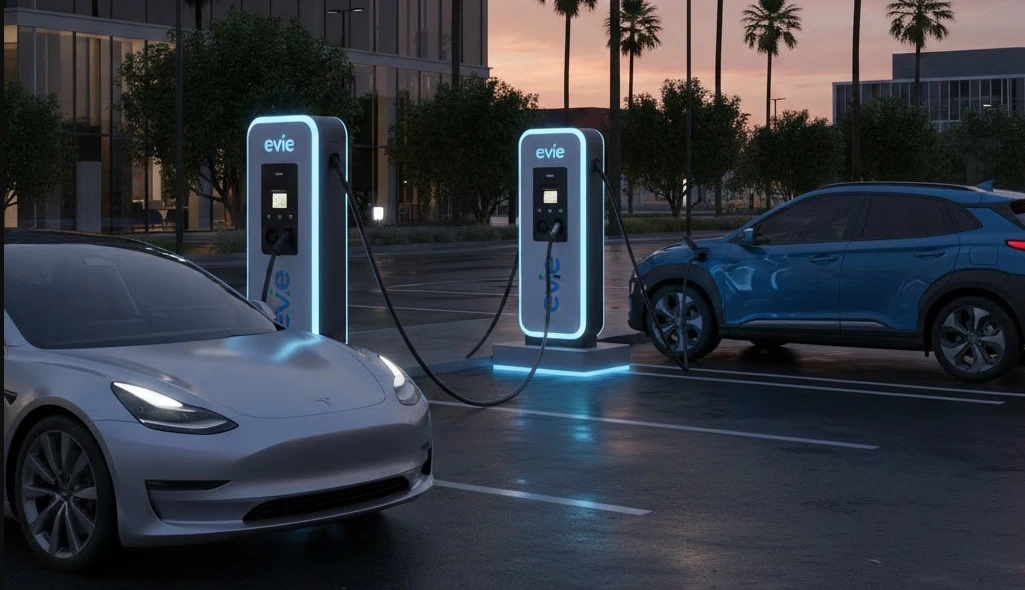
Electric vehicles are quiet.
Charging them is not always simple.
If you drive an EV in Australia, you have probably searched Evie Charging Station for one clear reason:
You needed power, not promises.
You wanted to know:
- What Evie actually is
- Where the chargers really are
- How fast they charge
- How much it costs
- Whether your EV will work
- And if you can rely on it on a long drive
This guide answers all of that.
Evie charging stations are part of Australia’s fast-charging backbone, built for highways, cities, and regional travel. They are not home chargers. They are not slow destination plugs. They exist to get you back on the road quickly.
Below, you will find clear facts, real examples, simple numbers, and honest limits about the Evie network operated by Evie Networks, written for real drivers, not marketing pages.
What Is an Evie Charging Station?
An Evie charging station is a public DC fast charger operated by Evie Networks.
Evie focuses on fast, short charging sessions rather than overnight charging. The goal is simple: add meaningful driving range in minutes, not hours.
Key characteristics:
- Public access
- DC fast charging (not basic AC plugs)
- Designed for travel and urban gaps
Evie stations support most EVs sold in Australia using CCS2 connectors, with CHAdeMO available at selected sites for older models.
How Big Is the Evie Charging Network?
As of 2025, Evie operates 300+ fast-charging locations across Australia.
Important context:
- One “location” often includes multiple chargers
- Many sites support two to four vehicles at once
- Total charging bays are much higher than the location count
For comparison, Australia passed 1,200 fast-charging sites nationwide by mid-2025, showing how quickly public EV infrastructure is expanding.
Evie is one of the core networks in that system.
Where Evie Charging Stations Are Actually Located (Real Examples)
Instead of listing hundreds of addresses, here is what matters more: where Evie stations are placed and why.
Major City Examples
| City | Evie Location | Why It’s There |
| Melbourne | Chadstone Shopping Centre | High-traffic retail + long parking time |
| Sydney | Alexandria Homemaker Centre | Apartment-heavy area |
| Brisbane | Fortitude Valley | Inner-city charging gap |
| Perth | Westfield Carousel | Metro fast charging |
| Adelaide | Westfield Marion | Suburban EV access |
These locations show Evie’s urban strategy: charge while you shop or park, not wait around.
Highway & Regional Examples
| Route | Location | Purpose |
| Melbourne ↔ Sydney | Gundagai (NSW) | Long-distance travel stop |
| Brisbane ↔ Cairns | Rockhampton (QLD) | Regional corridor |
| Perth ↔ Midwest | Geraldton (WA) | Remote route support |
| NSW North Coast | Coffs Harbour | Tourism and highway travel |
| Victoria regions | Ballarat | Regional EV access |
These stations exist to solve range anxiety, not convenience charging.
👉 For live availability, pricing, and exact bays, drivers rely on the Evie app, which updates in real time. Static lists go out of date quickly and are not reliable.
How Evie Charging Stations Work (In Real Life)
A real charging session looks like this:
- Open the Evie app
- Select a nearby station
- Park in a marked EV bay
- Plug in (usually CCS2)
- Start charging in the app
- Leave once you have enough range
There are no memberships and no staff. The system is fully self-service, like modern fuel stations.
How Fast Are Evie Charging Stations?
Evie uses DC fast chargers, typically rated at:
- 50 kW
- 150 kW
- Up to 350 kW at selected ultra-fast sites
What This Means for Drivers
- Many EVs can gain 200–300 km of range in 20–30 minutes
- Charging slows after ~80% battery level
- Your vehicle limits the speed, not the charger
This is why two cars can charge at different speeds on the same Evie station.
How Much Does It Cost to Charge at Evie?
Understanding charging costs is critical for EV drivers planning trips and budgeting EV travel. Unlike home charging, public fast charging prices vary by station, charger type, power output, and location.
Evie displays up-to-date pricing in its app and on its “Find a Charger” page, and rates are adjusted based on local energy costs and station power levels.
Typical Evie Charging Costs (2025–2026)
While individual station prices vary, these figures give a clear indicative range based on real data from Evie and observed charger price changes:
| Charger Type | Typical Pricing at Evie | Notes |
| 50 kW DC fast charger | ~0.50 AUD per kWh | Most common public fast charger price |
| 150 kW DC super-fast | ~0.60–0.68 AUD per kWh | Higher power, faster charging |
| 350 kW DC ultra-fast | ~0.65–0.73 AUD per kWh | Premium speed at highway sites |
| Indicative session cost (smaller EV) | ~14–27 AUD | Typical recharge for daily use |
| Indicative session cost (long-distance EV) | ~27–47 AUD | Larger battery or longer charge needed |
Key pricing details:
- Evie’s public chargers do not have fixed pricing across all stations; rates vary by site and power output.
- Higher-power chargers typically cost more per kWh but deliver significantly faster charging.
- Pricing is shown in the Evie app before you start charging, helping drivers compare costs in real time.
Example Cost Calculation
If you charge 40 kWh at $0.64 per kWh, the session cost would be roughly:
0.64 × 40 = $25.60 AUD, a typical mid-range session for many EVs.
Member Discounts & Offers
Some partners provide discounts that reduce these costs:
- RACQ members can save about 4 c/kWh for up to 1,000 kWh annually at select Evie stations in Queensland and Northern NSW.
Quick Context: How This Compares to Other Charging Costs
For perspective, broader Australian fast-charging prices generally fall within a similar range:
- National DC fast charging often ranges from $0.55 to $0.75 per kWh across networks.
- Home charging (off-peak) is typically $0.25–$0.45 per kWh, significantly cheaper but much slower.
This comparison helps drivers understand why public stations cost more; they deliver speed and convenience, not just energy.
Which EVs Can Use Evie Charging Stations?
Evie charging stations are designed to work with most electric vehicles sold in Australia today, as long as the vehicle supports DC fast charging and uses a compatible connector.
Here’s the clear breakdown, without guesswork.
EVs That Work With Evie Charging Stations
Most modern EVs in Australia use the CCS2 (Combined Charging System Type 2) connector. Evie’s network is built primarily around this standard.
EV brands commonly compatible with Evie chargers include:
- Tesla (all newer models with CCS2 support or an adapter)
- Hyundai (IONIQ series, Kona Electric)
- Kia (EV6, EV9, Niro EV)
- BYD (Atto 3, Dolphin, Seal)
- MG (MG4, ZS EV)
- Polestar (Polestar 2)
- Volvo (EX30, XC40 Recharge)
- BMW, Mercedes-Benz, and Audi electric models sold in Australia
These vehicles can use Evie’s 50 kW, 150 kW, and ultra-fast 350 kW DC chargers, depending on what the car itself supports.
EVs With CHAdeMO Support
Some older EVs use the CHAdeMO connector. Evie still supports this standard at selected locations, though it is becoming less common.
Examples include:
- Older Nissan Leaf models
- Older Mitsubishi Outlander PHEV (limited DC capability)
Availability of CHAdeMO plugs is shown clearly in the Evie app before you arrive.
EVs That May NOT Work With Evie Fast Chargers
Not every electrified vehicle can use Evie’s DC fast chargers.
These include:
- Plug-in hybrid vehicles (PHEVs) that do not support DC fast charging
- Older or low-range EVs designed only for AC charging
- Vehicles limited to single-phase or slow AC charging only
For these vehicles, slower destination chargers or home charging are required instead.
Why Charging Speed Varies Between EVs
Even if two EVs use the same Evie charger, they may charge at very different speeds.
That’s because the vehicle controls the charging rate, not the charger.
Charging speed depends on:
- Battery size and chemistry
- Maximum DC charging capacity of the vehicle
- Battery temperature
- Current battery level (charging slows after ~80%)
For example, a vehicle limited to 100 kW will not charge faster on a 350 kW Evie charger.
How to Check Compatibility Before You Arrive
The most reliable way to confirm compatibility is through the Evie app, which shows:
- Connector types available at each station
- Maximum power output
- Real-time availability
This avoids surprises and helps drivers plan stops confidently.
Evie vs Other Australian Charging Networks (Quick Reality Check)
| Charging Network | Main Focus | Typical Charger Types | Best For | Key Limitation |
| Evie Networks | Open-access DC fast charging | 50 kW, 150 kW, up to 350 kW | Highway travel, regional routes, mixed-brand EVs | App required; pricing varies by site |
| Tesla Supercharger | High-speed charging | 150–250 kW (V3) | Tesla owners, fast turnaround | Limited access for non-Tesla EVs |
| Chargefox | Mixed public network | AC + DC (50–350 kW) | City + regional coverage, flexibility | Experience varies by location |
| BP Pulse / AmpCharge | Growing metro-focused network | DC fast (varies by site) | Urban top-ups, convenience stops | Smaller footprint nationally |
| Local council / private networks | Destination charging | Mostly AC (7–22 kW) | Long parking stays (work, shopping) | Slow charging; not for road trips |
Real Limits Drivers Should Expect
Even with a strong network like Evie, public EV charging has some real-world limits. Here’s what drivers should expect in simple terms:
- Chargers can be busy during holidays and weekends
- You may need to wait for your turn at popular highway stops
- Charging speed can be slower for some EV models
- Charging usually slows down after 80% battery level
- You need a working mobile signal to use the app
- Prices can vary from one station to another
- Extreme heat or cold can reduce charging speed
- Not all locations have multiple chargers, so availability matters
Knowing these limits helps drivers plan better and avoid frustration on the road.
Also Read: Wearable Health Trackers: New Devices Predicting Health Problems Early
The Straight Answer
If you drive an EV in Australia, Evie charging stations are not optional infrastructure anymore. They are part of how long-distance and regional EV travel works today.
They are not perfect. They are not cheap. But they are practical, widespread, and designed for real driving, not theory.
FAQs
What is an Evie charging station used for?
Fast public charging for EVs when home charging is not available.
Are Evie charging stations only in cities?
No. Many are placed on highways and in regional towns.
Do I need the Evie app to charge?
Yes. The app is required to start and pay for sessions.
Is Evie charging expensive?
It costs more than home charging but is designed for travel convenience.
Can I rely on Evie for road trips?
Yes. Stations are placed along major travel corridors.
Similar Posts
How Cloud Infrastructure Works: Beginner to Advanced Explained
Fix: Wireless Internet Connected, But No Internet
Google DeepMind’s AlphaEarth in 2025: Satellite Embeddings, Use Cases & How It Works