
Elon Musk Predicts 10 Billion Humanoid Robots by 2040 at $20,000 Each
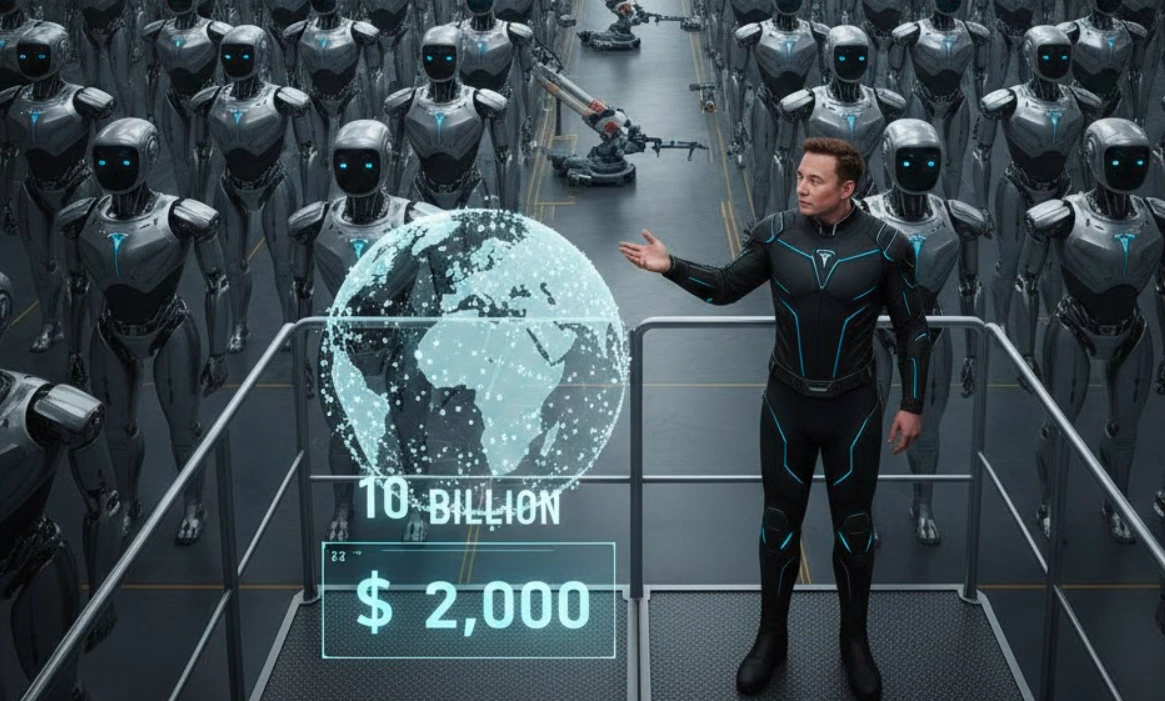
Ten billion humanoid robots.
That’s the figure Elon Musk has floated for the period leading up to 2040, a number that would outnumber the projected global human population. According to Musk, rapid advances in robotics, automation, AI, and large-scale manufacturing could make this scenario realistic rather than science fiction.
If your first reaction is disbelief, you’re not wrong to question it. So let’s break this down carefully: what Musk actually means, why he thinks this scale is possible, and what would have to be true for it to happen.
What Elon Musk Is Really Predicting
Musk’s projection is not just about robots existing in labs or factories. He’s talking about general-purpose humanoid robots, capable of performing physical tasks across industries, homes, and services.
His core assumptions are simple:
- Robotics will follow a manufacturing cost curve similar to cars and electronics
- AI models will improve faster than human training cycles
- Physical robots will be produced at a Gigafactory-level scale
- Demand for labor automation will keep accelerating globally
Under this logic, humanoid robots wouldn’t be rare machines. They would become mass-produced labor units.
Also Read: Will Optimus AI Robots Replace Surgeons? Elon Musk’s Claim vs Medical Reality
The Manufacturing Argument Most People Miss
One reason Musk believes his timeline is achievable comes from Tesla’s own factory history.
He frequently points out how quickly Tesla scaled large industrial facilities:
- Shanghai Gigafactory: completed in about 11 months
- Berlin Gigafactory: roughly 18 months
- Texas Gigafactory: about 14 months
These aren’t software launches. They are massive, physical manufacturing plants.
From Musk’s perspective, this proves that industrial infrastructure can scale far faster than traditional timelines suggest, especially when processes are standardized and vertically integrated.
Why $20,000–$25,000 Robots Matter More Than the Robot Itself
The most important part of Musk’s prediction isn’t the number of robots. It’s the price.
He has suggested future humanoid robots could cost between $20,000 and $25,000, roughly the price of a mid-range car.
Why this matters:
- At that price, robots stop being experimental tools
- Businesses can justify them economically
- Leasing and service models become viable
- Global adoption accelerates dramatically
Once automation becomes cheaper than long-term human labor, adoption no longer depends on novelty. It becomes a financial decision.
Can the World Actually Produce 10 Billion Robots?
This is where skepticism is valid.
To reach 10 billion units, the world would need:
- Massive supply chains for motors, sensors, chips, and batteries
- Energy infrastructure to support charging and operation
- Standardized designs to avoid fragmentation
- Global regulatory acceptance
However, consider this comparison:
- Over 1.4 billion cars exist globally today
- Smartphones reached billions of units in under two decades
If humanoid robots follow a similar industrial pattern, multi-billion scale is not impossible, but it would require unprecedented coordination and demand.
Why Musk Thinks Demand Will Exist Everywhere
Musk’s reasoning isn’t limited to factories.
He believes humanoid robots could be used for:
- Manufacturing and logistics
- Construction and infrastructure
- Elder care and healthcare support
- Household and service tasks
- Dangerous or undesirable jobs
As populations age and labor shortages grow, especially in developed economies, the economic pressure to automate physical work increases.
From this viewpoint, robots are not replacing humans out of choice, but out of necessity.
The Timeline Problem: Where Optimism Meets Reality
This is where Musk’s critics push back.
Producing billions of robots by 2040 would require:
- Breakthroughs in robot reliability
- Dramatic cost reductions in components
- Rapid improvements in autonomy and safety
- Social and legal acceptance at scale
Even if the technology improves quickly, deployment tends to move more slowly than innovation, especially when machines interact with people daily.
History shows Musk often underestimates social and regulatory friction, even when technology advances rapidly.
What This Would Mean If He’s Even Partly Right
Even if Musk’s numbers are off by half or more, the implications are still enormous.
A world with hundreds of millions or a few billion humanoid robots would:
- Reshape labor markets
- Change how productivity is measured
- Force new economic and policy models
- Redefine the relationship between work and income
In that sense, the exact number matters less than the direction.
What You Should Take Away From This
If you’re expecting 10 billion robots walking around tomorrow, that’s unrealistic.
But if you’re watching the trajectory of automation, Musk’s prediction highlights something important:
Physical AI is moving from concept to industrial reality.
Robots are getting cheaper.
Factories are scaling faster.
And the demand for automated labor isn’t slowing down.
The Bottom Line
Elon Musk’s prediction of 10 billion humanoid robots by 2040 is bold, controversial, and easy to dismiss.
But when you look at:
- Manufacturing speed
- Cost targets
- Global labor pressure
- Historical scaling patterns
…it becomes harder to ignore.
Even if the final number is far lower, the shift toward mass-scale humanoid robotics appears less like science fiction and more like a long-term industrial transformation.
FAQs
Did Elon Musk really say there could be 10 billion robots by 2040?
Yes. Musk has said that rapid advances in AI, robotics, and manufacturing could lead to more than 10 billion humanoid robots globally by 2040, potentially outnumbering humans, if large-scale production and demand continue to accelerate.
How much does Elon Musk think humanoid robots will cost?
Musk has suggested future humanoid robots could cost between $20,000 and $25,000, similar to a mid-range car. At this price, robots could become economically viable for businesses and households, accelerating adoption worldwide.
Is it realistic to produce billions of humanoid robots?
Producing billions of robots would be extremely challenging but not impossible. It would require massive factories, global supply chains, energy infrastructure, and standardized designs, similar to how cars and smartphones scaled to billions of units over time.
Why does Elon Musk think robots can scale so fast?
Musk points to Tesla’s factory history, where major plants were built in 11 to 18 months, as evidence that industrial infrastructure can scale rapidly when designs are standardized and vertically integrated.
What would billions of humanoid robots be used for?
Humanoid robots could be used in manufacturing, logistics, construction, elder care, healthcare support, and household tasks, especially in regions facing labor shortages and aging populations.
Similar Posts
Classroom 30x Tips & Tricks (2025): How to Play Safely, Boost Focus & Get the Best Game Experience
Dragonflight Talent Calculator: Enhancing Your Strategies
Unblocked Games 66: Unlocking Limitless Gaming Adventures and Fun