

Crypto Wire Transfer: Bridging Traditional Banking and Digital Assets

As digital currencies become more integrated into mainstream finance, new methods of moving money are emerging. One concept gaining attention is the crypto wire transfer, a process that combines elements of traditional bank wire transfers with blockchain-based cryptocurrency transactions. While the term can mean different things depending on context, it generally refers to transferring funds between bank accounts and cryptocurrency platforms or sending large-value crypto transactions with the speed and structure of a wire transfer.
This article explores what crypto wire transfers are, how they work, their advantages and risks, and how they compare to traditional wire systems.
Understanding Traditional Wire Transfers
Before diving into crypto wire transfer, it’s helpful to understand how conventional wire transfers operate.
A traditional wire transfer is an electronic movement of funds between banks or financial institutions. Systems such as SWIFT (Society for Worldwide Interbank Financial Telecommunication) facilitate international transfers by securely transmitting payment instructions between banks.
Key features of traditional wire transfers:
- Bank-to-bank transactions
- Often used for large sums
- Typically irreversible once processed
- Can take several hours to several days (especially internationally)
- May involve intermediary banks and fees
Although reliable, wire transfers can be slow and expensive, particularly for cross-border payments.
What Is a Crypto Wire Transfer?
A crypto wire transfer generally refers to one of the following:
- Bank-to-Crypto Exchange Transfer
Sending fiat currency (such as USD or EUR) via bank wire to a cryptocurrency exchange to purchase digital assets. - Crypto-to-Bank Withdrawal via Wire
Converting cryptocurrency into fiat currency and withdrawing it to a bank account using a wire transfer. - Large-Value Crypto Transaction
Sending cryptocurrency directly from one wallet to another in a manner comparable to a wire transfer often involves significant sums and requires heightened security verification.
Unlike traditional wires, cryptocurrency transactions are processed on blockchain networks such as Bitcoin or Ethereum. These networks validate transactions through decentralized consensus mechanisms rather than central banking systems.
How Crypto Wire Transfers Work
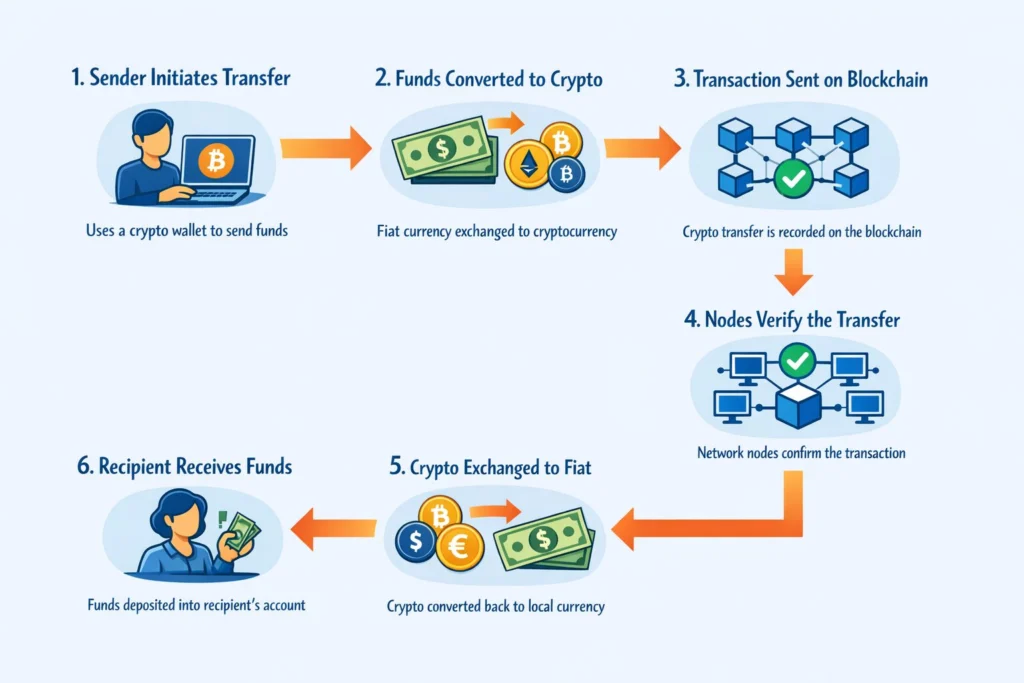
1. Sending Fiat to a Crypto Exchange
If you want to buy cryptocurrency using a bank wire:
- You initiate a wire transfer from your bank.
- Funds are sent to the crypto exchange’s bank account.
- Once the exchange receives and verifies the funds, your account is credited.
- You can then purchase digital assets.
This method is commonly used for large deposits because wire transfers typically have higher limits than debit or credit card payments.
2. Sending Crypto to Another Wallet
If you’re transferring crypto directly:
- You enter the recipient’s wallet address.
- Specify the amount.
- Pay a network fee (also called a gas fee on Ethereum).
- The transaction is validated and recorded on the blockchain.
Depending on the network, confirmation times vary:
- Bitcoin: ~10 minutes per block
- Ethereum: Often seconds to minutes
- Other networks may process even faster
Once confirmed, transactions are generally irreversible.
3. Converting Crypto to Fiat and Withdrawing
To move funds from crypto back to a bank:
- Sell your cryptocurrency on an exchange.
- Request a fiat withdrawal.
- The exchange sends funds via wire transfer to your bank account.
Processing time depends on the exchange and banking systems, usually 1 to 5 business days.
Benefits of Crypto Wire Transfers
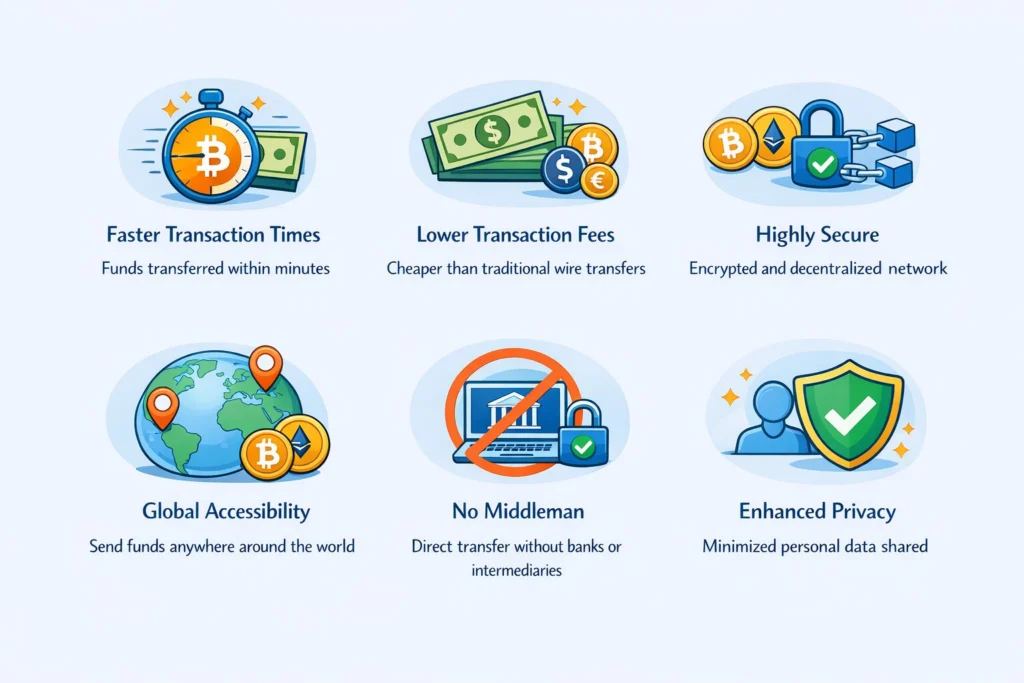
1. Faster Cross-Border Transactions
Traditional international wires can take days due to intermediary banks. Crypto transactions often settle much faster, especially across borders.
2. Lower Fees (in Some Cases)
Blockchain transaction fees may be lower than international wire fees, especially for large sums. However, this depends on network congestion and exchange charges.
3. Accessibility
Cryptocurrency transactions don’t require traditional banking infrastructure. Anyone with internet access and a crypto wallet can participate.
4. Transparency
Blockchain transactions are publicly recorded and traceable, increasing transparency compared to some traditional banking processes.
Risks and Considerations
While crypto wire transfers offer advantages, they also carry risks.
1. Irreversibility
Once a crypto transaction is confirmed on the blockchain, it cannot be reversed. Sending funds to the wrong address can result in permanent loss.
2. Volatility
Cryptocurrency values fluctuate rapidly. If you transfer funds in crypto, the value may change significantly before conversion to fiat.
3. Regulatory Compliance
Governments worldwide are implementing regulations for crypto transactions. In the United States, agencies like the U.S. Securities and Exchange Commission and the Financial Crimes Enforcement Network oversee aspects of digital asset compliance, including anti-money laundering (AML) rules.
Users must comply with Know Your Customer (KYC) requirements on most reputable exchanges.
4. Security Risks
Crypto transactions require safeguarding private keys and account credentials. Unlike bank accounts, lost keys often permanently mean lost funds.
Comparing Crypto Wire Transfers and Traditional Wires
| Feature | Traditional Wire Transfer | Crypto Wire Transfer |
| Speed (Domestic) | Same day or 1 day | Minutes to hours |
| Speed (International) | 1–5 business days | Minutes to hours |
| Reversibility | Rare but sometimes possible | Nearly impossible |
| Fees | Often high | Variable, often lower |
| Intermediaries | Multiple banks | Decentralized network |
| Regulation | Heavily regulated | Increasing regulation |
The key difference lies in decentralization. Traditional wires rely on centralized financial institutions, while crypto transfers rely on distributed blockchain networks.
Use Cases for Crypto Wire Transfers
- International Business Payments
Companies paying overseas suppliers may use crypto to reduce settlement times. - Investment Funding
Investors are wiring large sums to exchanges to purchase digital assets. - Remittances
Individuals sending money to family members abroad. - Institutional Transfers
Hedge funds and financial institutions are moving large volumes between wallets or exchanges.
Best Practices for Safe Transfers
If you plan to use crypto wire transfers:
- Double-check wallet addresses before sending.
- Use reputable exchanges with strong security measures.
- Enable two-factor authentication (2FA).
- Consider transferring a small test amount first.
- Stay informed about local regulations and tax obligations.
Security and due diligence are essential when handling digital assets.
The Future of Crypto Wire Transfers
The financial industry is evolving toward faster, more efficient payment systems. Central banks are exploring digital currencies (CBDCs), and blockchain technology continues to develop. Traditional financial institutions are also integrating crypto services, narrowing the gap between conventional wires and blockchain transfers.
As infrastructure improves and regulatory clarity increases, crypto wire transfers may become a more standardized part of global finance.
Conclusion
Crypto wire transfers represent a hybrid approach to moving money in the digital age. Whether transferring fiat to a crypto exchange or sending cryptocurrency directly across borders, this method combines the familiarity of traditional wire systems with the innovation of blockchain technology.
While offering speed, accessibility, and potential cost savings, crypto wire transfers also entail risks, including volatility, irreversibility, and regulatory complexity. Understanding how these systems work is essential for individuals and businesses looking to navigate the evolving financial landscape safely and effectively.
As digital finance continues to mature, crypto wire transfers are likely to play an increasingly important role in global transactions.

Similar Posts
The Importance of Travel Chargers for Modern Explorers
What is a Virtual Appointment with a Doctor?
Meta AI Tested: Its Necessity May Be Questionable, But It’s Free