
$200M ASML EUV Machines vs China’s 6-Year Breakthrough: Is the 13.5nm Chip Monopoly Cracking in 2026?
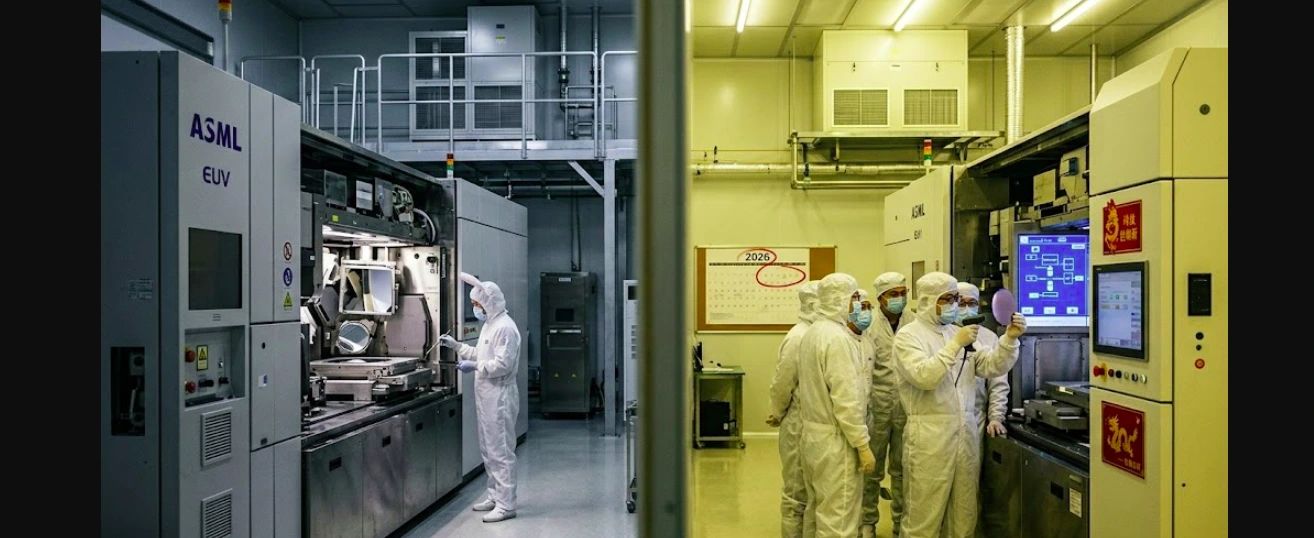
ASML, EUV, and the Red Line in Semiconductor History
For more than two decades, the most advanced chips in the world depended on a single company: ASML.
From AI accelerators powering hyperscale data centers to advanced military processors and smartphone chips, every cutting-edge node below 7nm required one thing: Extreme Ultraviolet (EUV) lithography.
The United States spent nearly twenty years building export controls to ensure China never accessed that technology.
Now, reports suggest Chinese researchers have successfully generated EUV light domestically, the hardest bottleneck in advanced chip manufacturing.
This is not yet mass production.
But it may be the most strategically important semiconductor development in years.
Let’s break it down.
Why EUV Is the Backbone of Modern AI Chips
Semiconductor manufacturing works by projecting light through a mask onto silicon wafers to etch circuits.
The shorter the wavelength of light, the smaller the features that can be printed.
- Deep Ultraviolet (DUV): ~193nm wavelength
- EUV: 13.5nm wavelength
That reduction enables:
- 7nm chips
- 5nm chips
- 3nm chips
- 2nm nodes (emerging)
Without EUV, producing advanced AI GPUs becomes significantly more complex, expensive, and yield-constrained.
The ASML Monopoly Explained
ASML invested over $20+ billion and more than 20 years to commercialize EUV.
Each EUV machine:
- Costs approximately $150–$200 million
- Weighs around 180 tons
- Contains over 100,000 precision components
- Uses ultra-polished mirrors manufactured by Germany’s Carl Zeiss
- Generates plasma hotter than the surface of the sun to produce 13.5nm light
No other company has successfully brought a full commercial EUV scanner to mass production.
EUV Cost Structure: Why It’s So Hard to Replicate
Below is an approximate breakdown of EUV system economics:
EUV Machine Cost Structure (Estimated)
| Component Category | Approximate Share of Cost | Notes |
| Optical System (Zeiss mirrors) | 30–35% | Ultra-precision reflective optics |
| Plasma Light Source | 20–25% | Laser-driven tin droplet plasma |
| Mechatronics & Stage Systems | 15–20% | Nanometer precision wafer positioning |
| Control Software & Algorithms | 5–10% | Stability, correction, yield optimization |
| Assembly & Integration | 10–15% | Highly specialized supply chain |
| R&D Amortization | Significant | Decades of sunk cost |
Total system cost: $150–$200M per unit
A typical advanced fab may require multiple EUV scanners.
The Sanctions Strategy Against China
The U.S., Netherlands, and Japan coordinated export controls to block:
- EUV machine exports to China
- Advanced DUV tools
- Key semiconductor components
- High-end GPU shipments
The strategy aimed to freeze China’s ability to produce sub-7nm chips.
The assumption was clear:
Without EUV, China cannot compete at the bleeding edge.
What China Claims to Have Achieved
Reports indicate that Chinese researchers have:
- Successfully generated EUV light in laboratory conditions
- Developed experimental plasma systems
- Advanced domestic lithography research through state-backed programs
Huawei has reportedly coordinated much of the semiconductor push after being cut off from advanced chip supplies.
State funding for semiconductor independence has reportedly reached tens of billions of dollars.
Important distinction:
Generating EUV light ≠ Building a commercial EUV scanner.
But it breaks the most difficult technical barrier.
Node Evolution: Why EUV Determines AI Power
Here’s how semiconductor nodes have evolved:
Advanced Semiconductor Node Timeline
| Year | Node | Technology | Key Enabler |
| 2014 | 16nm | FinFET | Advanced DUV |
| 2018 | 7nm | FinFET | Initial EUV adoption |
| 2020 | 5nm | FinFET | Heavy EUV usage |
| 2022 | 3nm | Gate-All-Around | Extensive EUV |
| 2024+ | 2nm | GAA / Nanosheet | High-NA EUV |
Leading manufacturers like:
- TSMC
- Samsung Electronics
Depend on EUV to achieve these nodes.
AI accelerators from Nvidia and processors from Apple rely on these advanced fabrication technologies.
Without EUV, scaling AI compute density becomes far more difficult.
Why This Is a Psychological Shift
Even if China cannot mass-produce EUV chips today, the message changes everything:
- EUV is no longer perceived as untouchable.
- Monopoly confidence weakens.
- Sanctions may accelerate domestic innovation.
History shows that technological embargoes often stimulate internal R&D acceleration.
What was designed as containment may have triggered competition.
What China Still Needs to Prove
To truly challenge ASML, China must demonstrate:
- Stable plasma generation at production scale
- Integrated optical systems with nanometer precision
- High wafer yield rates
- Commercial fab deployment
Lab breakthroughs do not equal fab reliability.
The gap between experiment and industrial deployment is enormous.
The AI Infrastructure War
This development matters because AI dominance depends on semiconductor control.
Advanced AI training requires:
- Cutting-edge GPUs
- High-bandwidth memory
- Advanced packaging
- Sub-5nm process nodes
If China closes the EUV gap:
- AI compute parity becomes possible
- Military semiconductor independence increases
- Global tech alliances shift
The race is no longer just about chips.
It is about AI infrastructure sovereignty.
Strategic Implications for Other Nations
Countries like India face a strategic decision:
- Focus on chip design (fabless model)?
- Or invest in lithography, tooling, and manufacturing infrastructure?
Semiconductor power lies not only in chip design, but in the machines that create chips.
The EUV battle demonstrates that manufacturing tools define long-term use.
Final Assessment: Power Shift or Premature Hype?
ASML still dominates.
The Western semiconductor alliance remains ahead.
China has not yet demonstrated commercial EUV mass production.
But something important has changed:
The barrier is no longer psychological.
The race has shifted from access denial to parallel development.
And that may define the next decade of AI, military computing, and geopolitical technology power.
FAQs
1️⃣ Did China really develop EUV lithography technology?
China has reportedly demonstrated EUV light generation in laboratory conditions, which is a major technical milestone. However, it has not yet confirmed commercial-scale EUV lithography machines comparable to those produced by ASML.
2️⃣ What is EUV lithography and why is it important?
EUV (Extreme Ultraviolet) lithography uses 13.5nm wavelength light to print extremely small transistor features on silicon wafers. It is essential for producing 5nm, 3nm, and upcoming 2nm chips, which power advanced AI systems, smartphones, and high-performance computing.
3️⃣ Why was China blocked from buying EUV machines?
The United States, along with the Netherlands and Japan, imposed export controls to prevent China from accessing EUV technology. The goal was to limit China’s ability to manufacture advanced AI and military-grade semiconductors.
4️⃣ Can China now manufacture 5nm or 3nm chips independently?
There is no verified evidence that China can mass-produce 5nm or 3nm chips using a domestic EUV system yet. While progress in research has been reported, building a full commercial EUV scanner and achieving high production yields remains a significant challenge.
5️⃣ How would China’s EUV success impact Nvidia, Apple, and global chip markets?
If China eventually commercializes EUV lithography, it could reduce reliance on Western suppliers and reshape global semiconductor supply chains. Companies like Nvidia, Apple, and leading fabs such as TSMC could face increased geopolitical and competitive pressure.
Similar Posts
Pros of Telemedicine and Its Benefits for Healthcare Access
Amazon’s Rapid Expansion in Australia Alerts Coles and Woolworths to Competitive Threat
Maximizing Returns with Accurate Commercial Property Valuations and Superfund Valuations