
Automation vs Human Work: Cost, Speed, Accuracy & What Data Says (2026)
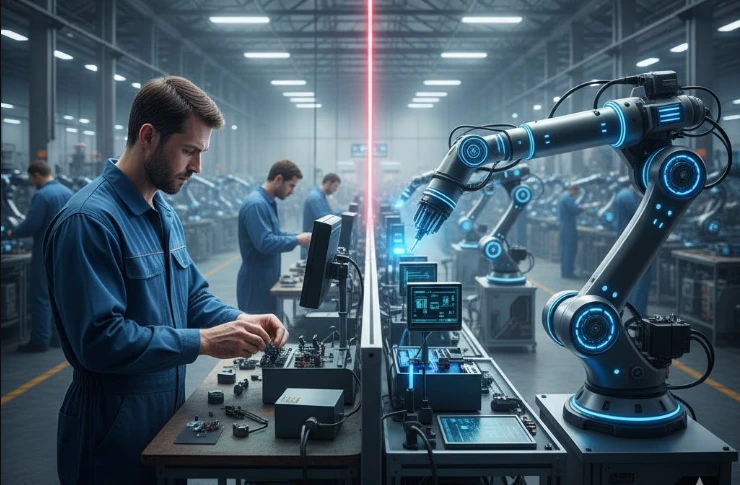
By 2026, more than 50% of all workplace tasks globally will involve some level of automation, yet over 80% of critical decisions will still require human judgment. That is the reality behind the automation vs human work debate.
Data from global workforce and productivity studies shows that automation now delivers 20–30% cost savings, completes tasks up to 5× faster, and reduces error rates by as much as 90% in repetitive workflows. At the same time, humans continue to outperform machines in areas like ethics, creativity, leadership, and complex decision-making.
So the real question is no longer whether automation is better than human work.
It is where automation wins, where humans still lead, and how both are combined in 2026 to achieve the best outcomes.
This article breaks down automation vs human work using verified data on cost, speed, and accuracy, and explains why the future of work is hybrid, not binary.
What Does “Automation vs Human Work” Mean in 2026?

In 2026, automation is no longer limited to factory machines. It includes:
- AI-driven software automation
- Robotic Process Automation (RPA) for office workflows
- Physical robots in manufacturing and logistics
- Intelligent systems handling routing, analysis, and monitoring
Human work, on the other hand, still dominates areas that require context, values, and accountability.
The comparison today is not replacement vs survival.
It is task-by-task performance.
Is Automation Cheaper Than Human Labor Long Term?
Yes, for high-volume and repetitive tasks, automation is cheaper over time.
Verified cost data
- The true cost of a human employee is 1.25–1.4× base salary once benefits, training, and overhead are included.
- Automation initiatives reduce operational costs by 20–30% in functions such as finance, HR, and supply chain.
- RPA and AI automation typically reach ROI within 12–18 months for repetitive workflows.
Why cost shifts over time
- Human cost increases annually with wages and compliance
- Automation cost per task approaches zero at scale
Cost verdict:
Humans are cheaper short term. Automation is cheaper long-term.
How Much Faster Is Automation Compared to Humans?

Automation is orders of magnitude faster, not just slightly quicker.
Speed benchmarks
- Automated systems process tasks in milliseconds
- Human task completion averages minutes per action
- Automated logistics routing improves delivery speed by 25–40%
- AI-assisted customer support resolves issues up to 5× faster
Humans work sequentially. Automation works in parallel, continuously.
Speed verdict:
Automation dominates any time-sensitive or high-volume workload.
Is Automation More Accurate Than Humans?
Yes, when tasks are structured and consistent.
Accuracy data
- Manual data entry error rates: 1–5%
- Automated processing error rates: below 0.1% in controlled systems
- Manufacturing automation reduces defects by up to 90%
Where accuracy drops
Automation struggles when:
- Context changes suddenly
- Data quality is poor
- An ethical or ambiguous judgment is required
Accuracy verdict:
Automation is precise. Humans are adaptive.
Does Automation Increase Productivity More Than Human Work?
Yes, especially over long periods.
Productivity metrics
- Automation increases productivity by 30–50% in repetitive workflows
- Humans average 3–4 hours of peak productivity per day
- Automated systems maintain 100% output consistency
Automation does not slow down, fatigue, or disengage.
Productivity verdict:
Automation multiplies output. Humans optimize outcomes.
Where Do Humans Still Outperform Automation?
Humans remain irreplaceable in areas involving:
- Ethical judgment
- Creative problem-solving
- Leadership and accountability
- Emotional intelligence
- Crisis response
- Negotiation and persuasion
Automation follows rules. Humans understand when rules should change.
Will Automation Replace Human Jobs Completely?
No, and the data is clear.
Job impact reality
- About 60% of occupations have 30% of tasks that can be automated
- Only ~5% of jobs are fully automatable with current technology
- Automation creates new roles within 2–3 years of adoption
Automation replaces tasks, not entire professions.
What Is the Real ROI of Automation?
Automation ROI depends on task volume and repeatability.
High ROI areas:
- Data processing
- Finance operations
- Customer support triage
- Supply chain optimization
Low ROI areas:
- Creative work
- Strategic leadership
- Unpredictable human interaction
ROI verdict:
Automation pays off where repetition and scale exist.
Which Human Tasks Cannot Be Automated?
Tasks that resist automation include:
- Moral decision-making
- Value-based judgment
- Context-heavy reasoning
- Creative synthesis
- Human trust and relationship building
These tasks define why humans remain essential in 2026.
Automation vs Human Work: Side-by-Side Summary
| Factor | Automation | Human Work |
| Long-term cost | Lower | Higher |
| Speed | Extremely fast | Moderate |
| Accuracy (structured) | Very high | High |
| Accuracy (complex) | Limited | Strong |
| Creativity | Minimal | Strong |
| Ethics & judgment | Rule-based | Human-based |
| Accountability | System-level | Personal |
The Hybrid Model: How Work Actually Happens in 2026
The most successful organizations do not choose automation or humans.
They design systems where:
- Automation handles volume and speed
- Humans handle judgment and exceptions
- AI supports decisions, not authority
This hybrid approach delivers the best balance of cost, speed, accuracy, and trust.
Also Read: Can Neuralink Really Let Humans Control Technology With Their Brain?
Final Verdict: Automation vs Human Work
Automation wins on:
- Cost efficiency at scale
- Speed
- Consistency
Humans win on:
- Judgment
- Creativity
- Ethics
- Responsibility
In 2026, the future of work is not automation versus humans.
It is automation with humans, each doing what they do best.
FAQs
Is automation better than humans at work?
Automation is better at repetitive, high-volume, and rule-based tasks, while humans perform better in work that requires judgment, creativity, and ethical decision-making.
What jobs are most affected by automation?
Jobs involving repetitive tasks such as data entry, basic customer support, assembly line work, and routine analysis are the most affected by automation.
Can automation completely replace human workers?
No. Automation replaces specific tasks, not entire professions. Most jobs still require human oversight, decision-making, and accountability.
Why do companies prefer automation over hiring humans?
Companies prefer automation because it lowers long-term costs, works faster at scale, reduces errors, and provides predictable performance without fatigue or turnover.
What are the disadvantages of automation compared to humans?
Automation lacks creativity, emotional intelligence, ethical reasoning, and the ability to adapt quickly in unpredictable situations.
Is automation more reliable than human workers?
Automation is more reliable for consistent and repetitive tasks, but humans are more reliable when situations require flexibility, context, and moral judgment.
Will automation create new jobs in the future?
Yes. Automation creates new roles in system management, data analysis, AI oversight, maintenance, and reskilling-focused occupations.
Which industries rely most on automation today?
Manufacturing, logistics, finance, customer support, healthcare operations, and IT services rely heavily on automation to improve efficiency and accuracy.
How does automation affect workplace productivity?
Automation increases productivity by handling tasks faster and continuously, allowing humans to focus on higher-value and strategic work.
Is human work still necessary in an automated workplace?
Yes. Human work remains essential for leadership, ethics, creativity, complex problem-solving, and decision accountability.
Similar Posts
The Complete Buyer Agent Hiring Guide on the Gold Coast
Is TanzoHub the Ideal Project Management Solution? Unbiased Review
Smart Leadership Begins With Technology-Driven Mental Health Training