

AS400 in 2026: The Support Shift That Drives Modernization

You have sailed into 2026 with IBM i still running the workflows that keep your business upright. Orders still clear. Inventory still reconciles. Finance still closes. The green screen still does what it has done for decades.
That reliability is exactly why IBM i stays. It is also why modernization often gets postponed until a deadline shows up with teeth.
But the pressure is no longer just technological; it’s human. IDC projects that by 2026, over 90% of organizations worldwide will experience significant business impact from IT skills gaps. For IBM i environments that depend on specialized RPG developers and deeply experienced system administrators, the risk is not system failure. It is knowledge erosion. And that changes the modernization conversation from optional to inevitable.
And in 2026, a few deadlines are quietly lining up.
- January 31, 2026, is the end of support for Power9.
- September 30, 2026, marks the end of support for IBM i 7.4 and the transition to a limited service extension.
- April 30 is the date IBM stops selling IBM i 7.4, which changes the upgrade conversations for teams that keep pushing that decision forward.
None of this is meant to be alarmist. But it is the kind of calendar pressure that turns “we should modernize” into “we have to modernize” very quickly. That is why I am making this simple point.
AS400 iSeries support is no longer a maintenance line item. It is your modernization strategy in disguise.
Why Support Suddenly Matters More in 2026?
For years, many IBM i teams have managed risk with a familiar playbook.
- Keep the core stable
- Limit change.
- Rely on the fact that the platform rarely breaks.
That playbook works until the environment around IBM i changes faster than the system can keep up. In 2026, that external change is coming from three directions.
- First, lifecycle pressure, Hardware generations age out. OS releases shift from mainstream support to extended support. Security and compliance expectations do not slow down, even though your RPG program still runs.
- Second, integration expectations. Customers, partners, and internal teams now expect real-time visibility. Not tomorrow morning. Not after the nightly batch. They expect APIs, event-driven updates, and modern user experiences that do not require a terminal emulator.
- Third, the AI wave. Whether you are excited about it or tired of hearing about it, AI is shaping budgets and roadmaps. Leaders want forecasting, anomaly detection, automation, copilots, and faster delivery. IBM i data is valuable, but it cannot stay locked inside workflows that were never designed to feed modern analytics and AI tools.
This is the moment where “support” stops meaning “keep the lights on” and starts meaning “make change safe.”
The leadership mistake that shows up every year
When IBM i environments get attention, it is often because someone is proposing a big move.
- Migrate off the platform.
- Rewrite core applications.
- Replace the green screen with a brand new suite.
Those programs can succeed, but they also carry the highest risk because they try to change everything at once.
A smarter pattern is showing up more and more in mature IBM i shops. And that is nothing but- keep the core the same and extend the edge. That approach does not work without strong iSeries support, because it is support that gives you the discipline to modernize incrementally without destabilizing operations. If your IBM i support partner cannot help you modernize safely, then they are not a support partner. They are a break-fix vendor.
The real problem is not technology, it is skill and continuity.
The most common IBM i modernization constraint in 2026 is not the platform itself.
- It is the shortage of IBM i skills.
- It is knowledge sitting in a few people’s heads.
- It is undocumented workflows.
- It is fragile change processes where teams are scared to touch what works.
This is exactly why support matters.
- It creates continuity.
- It documents what is critical.
- It reduces dependency on one or two individuals.
- It makes upgrades and enhancements repeatable.
- It builds confidence that change will not break production.
What AS400 iSeries support Should Include in 2026
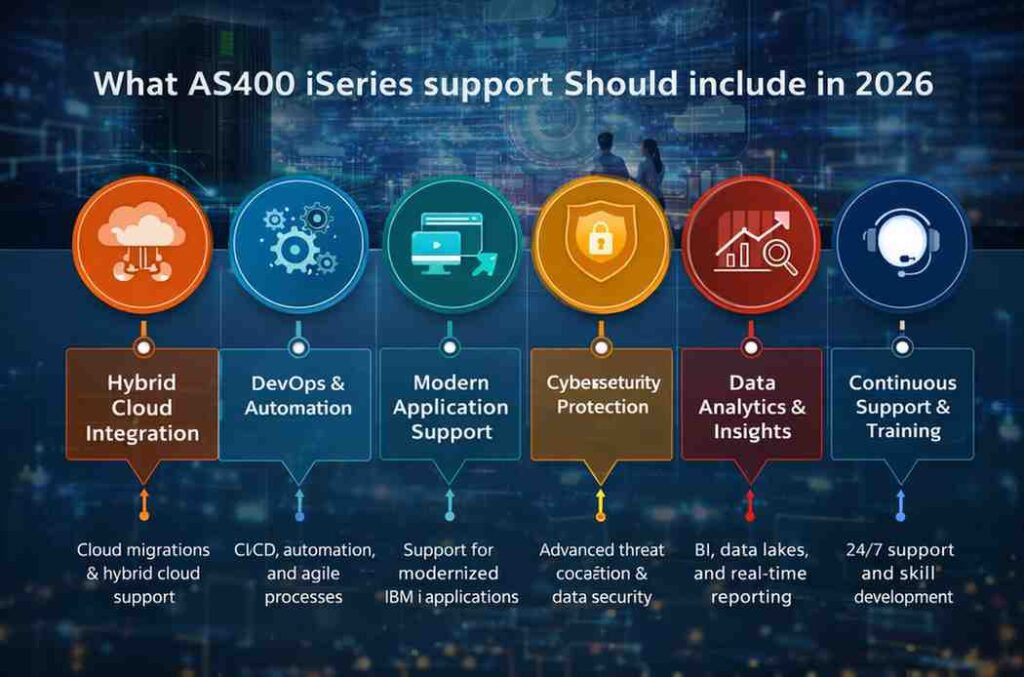
When people say “AS400 support,” they often mean fixing issues when something breaks. In 2026, that definition is too small. Real IBM i support is what keeps the platform stable, secure, and ready for change without disrupting daily operations.
Here are five support services that show up most often in IBM i environments, and why they matter.
1) Proactive monitoring and maintenance
Good support is preventative. It focuses on spotting issues early, resolving performance slowdowns, and keeping the system tuned so users do not feel instability.
This usually includes routine health checks, performance tuning, issue prevention, and maintenance planning.
2) Security services
Security is no longer a one-time setup. IBM i support often includes continuous monitoring, access control reviews, tighter authentication, and stronger protection for sensitive data.
The goal is simple. Reduce risk without slowing down the business.
3) Technical training and ongoing guidance
Support often includes helping teams operate IBM i correctly, follow better practices, and use the system efficiently. This also covers guidance on updates, changes, and common operational mistakes that create avoidable incidents.
4) Consulting and strategy support
This is the part many teams miss. Support is often where modernization starts.
A strong support partner helps you identify what to improve first, what can be modernized without rewriting core logic, and how to plan change without creating production risk. The work is practical and prioritized, not theoretical.
5) Backup and recovery readiness
Backups are only useful if recovery is predictable. IBM i support includes making sure backups are reliable, recovery steps are clear, and restore processes are tested.
This is what protects you when incidents stop being hypothetical.
Why These Services Matter
The outcomes are what make these services worth it:
- more stable system performance
- fewer disruptions and faster resolution when issues happen
- stronger security posture
- smoother upgrades and safer changes
- lower long-term cost by preventing recurring operational problems
The takeaway
IBM i has never been the problem. The risk comes from treating it like an island. In 2026, the pattern is clear: preserve the IBM i core, modernize the edges, and use deadlines as planning triggers, not panic triggers. AS400 iSeries support that keeps production steady while making AS400 modernization safe, repeatable, and faster. Start early, while you still have room to choose.

Similar Posts
Simplifying High-Risk Merchant Accounts for Online Businesses with HighRiskPay
How Australian Startups Use AI in FinTech in 2025?
Crypto30x Coins to Watch in 2025: Real Potential or Risky Bet?