
Will Optimus AI Robots Replace Surgeons? Elon Musk’s Claim vs Medical Reality

Elon Musk Says AI Robots Could Outperform Surgeons. Should You Take That Seriously?
In January 2026, Elon Musk made a bold prediction:
Humanoid robots could eventually handle complex medical procedures more consistently than human surgeons.
If that sounds alarming or exciting, your reaction is completely normal. Claims like this force a simple question: are we witnessing the future of healthcare, or just another optimistic tech forecast?
To answer that, we need to separate what is technically possible, what already exists, and what remains far out of reach.
What Musk Is Actually Arguing (Beyond the Headlines)
Strip away the headlines, and Musk’s argument is built on three measurable realities:
- Doctor and surgeon shortages are growing worldwide
- Medical training takes 10–15 years for complex specialties
- Human error increases with fatigue and workload
According to Musk, robots like Tesla’s Optimus could address these limits by working longer hours, learning faster through software updates, and applying identical techniques without variation.
This is not a claim about replacing doctors tomorrow. It’s a claim about long-term consistency at scale.
Why the Idea Sounds Plausible at First Glance
From a technical standpoint, parts of the argument make sense.
Modern robotic systems can already:
- Perform movements with sub-millimeter precision
- Eliminate hand tremors
- Repeat the same action thousands of times
- Improve outcomes in minimally invasive procedures
Robotic assistance is already used in operating rooms. So the idea that robots could play a larger role in surgery doesn’t come out of nowhere.
But assistance and autonomy are very different things.
What Medical Robots Can Actually Do Today
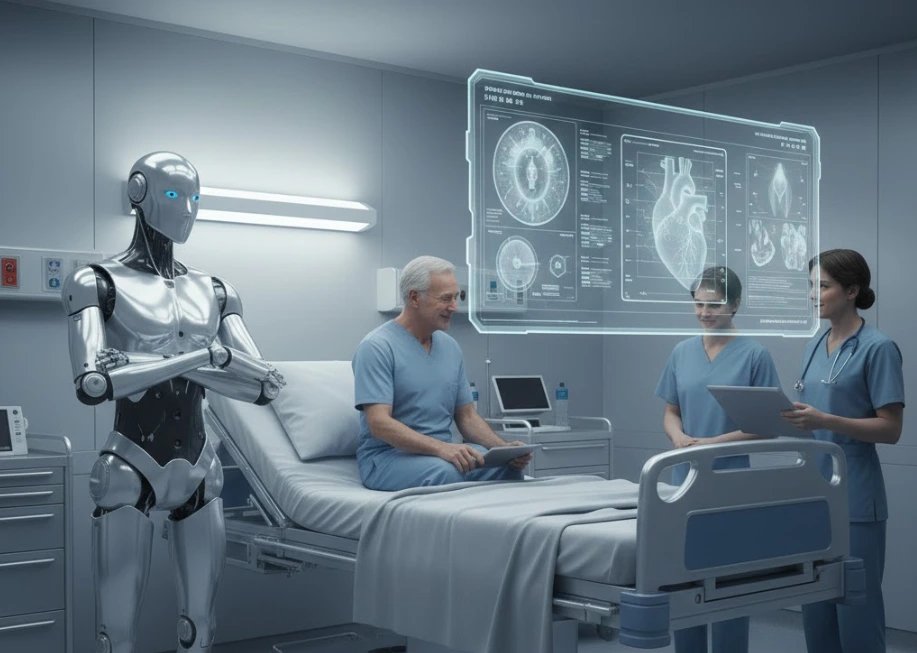
Here’s the reality most headlines skip.
Today’s surgical robots:
- Do not operate independently
- Do not make clinical decisions
- Do not adapt autonomously to unexpected complications
They are advanced tools, fully controlled by human surgeons. Every procedure still depends on human judgement, training, and responsibility.
There are no approved humanoid robots performing autonomous surgery in real clinical environments.
Why Surgery Is Not Just a Precision Problem
It’s easy to assume surgery is mostly about steady hands. In practice, it’s far more complex.
Real operations involve:
- Unpredictable anatomy
- Sudden bleeding or complications
- Ethical decisions under pressure
- Adjustments when things don’t go as planned
Surgeons constantly interpret incomplete information. Encoding that level of judgement into software remains one of the biggest unsolved challenges in medical AI.
Can Robots Really Learn Faster Than Surgeons?
Musk often points out that robots could be trained using:
- Millions of simulated procedures
- Continuous software updates
- Shared learning across machines
That’s partly true. AI can absorb data faster than humans. But medical expertise also includes:
- Patient communication
- Contextual judgement
- Legal accountability
- Ethical responsibility
These aren’t things you can simply “update” with new code.
Reducing Human Error vs Creating Systemic Risk
Another part of Musk’s argument is reducing human error.
Human error exists, especially under fatigue. But replacing it introduces a different risk: systemic failure.
If a surgeon makes a mistake, it affects one patient.
If a software system fails, it can affect many patients at once.
That’s why healthcare regulators treat autonomous medical systems far more cautiously than automation in other industries.
What Most Medical Experts Actually Agree On
Despite debate around timelines, there is broad agreement on a few points:
- AI will assist doctors more deeply
- Automation will improve consistency in narrow tasks
- Fully autonomous surgery is not close to approval
- Humans will remain responsible for decisions
Musk’s prediction highlights a direction, not a confirmed destination.
What This Means for You as a Patient
If you’re wondering whether robots will replace surgeons anytime soon, the answer is straightforward: no.
What you’re more likely to see is:
- AI helping surgeons plan procedures
- Robots assisting with precision tasks
- Reduced workload for medical staff
- Improved access to care in underserved regions
This is about augmentation, not replacement.
Why Musk’s Prediction Still Matters
Even if the timeline is optimistic, the conversation is important.
Healthcare systems face:
- Aging populations
- Staff shortages
- Rising costs
AI and robotics will be part of the solution. The real challenge is making sure adoption is safe, regulated, and ethical, not rushed.
Also Read: Can Neuralink Really Let Humans Control Technology With Their Brain?
The Bottom Line
Elon Musk’s claim isn’t science fiction, but it isn’t medical reality either.
Robots can be precise.
AI can assist.
But surgery depends on judgment, responsibility, and trust.
For now, robots remain tools.
Humans remain accountable.
FAQs
Will AI robots replace surgeons in the future?
No. AI robots are expected to assist surgeons, not replace them. While robots can improve precision and consistency in specific tasks, complex medical judgment, ethical decisions, and accountability still require human doctors.
Did Elon Musk say robots will perform surgery better than humans?
Yes. In January 2026, Elon Musk said rapid advances in AI, computing power, and robotics could allow humanoid robots to perform some medical procedures more consistently than humans in the future.
Can robots perform surgery on their own today?
No. There are no approved robots performing autonomous surgery. All robotic surgical systems currently require full human control and supervision by trained surgeons.
What medical robots are used in hospitals right now?
Hospitals use robot-assisted surgical systems that help surgeons improve precision, reduce tremors, and perform minimally invasive procedures. These robots do not make decisions or operate independently.
Is Tesla’s Optimus designed for medical surgery?
No. Optimus is a general-purpose humanoid robot designed for physical tasks, not a certified medical device. It is not approved or designed to perform surgery.
Why do experts doubt robot surgeons will replace humans soon?
Experts cite challenges such as unpredictable anatomy, emergency decision-making, ethical responsibility, regulatory approval, and legal accountability. These factors make full autonomous surgery far more complex than precision alone.
How can AI actually help doctors without replacing them?
AI can assist doctors by analyzing medical data, improving surgical planning, reducing fatigue-related errors, and supporting repetitive tasks. This approach improves outcomes while keeping humans responsible for final decisions.
Similar Posts
How AI Helps Detect Crypto Scams in Australia (2025)
Curious About Asana Login? Discover Its Importance and Process
$200M ASML EUV Machines vs China’s 6-Year Breakthrough: Is the 13.5nm Chip Monopoly Cracking in 2026?