
How Artificial Intelligence Is Quietly Transforming Smart Cities in Australia?
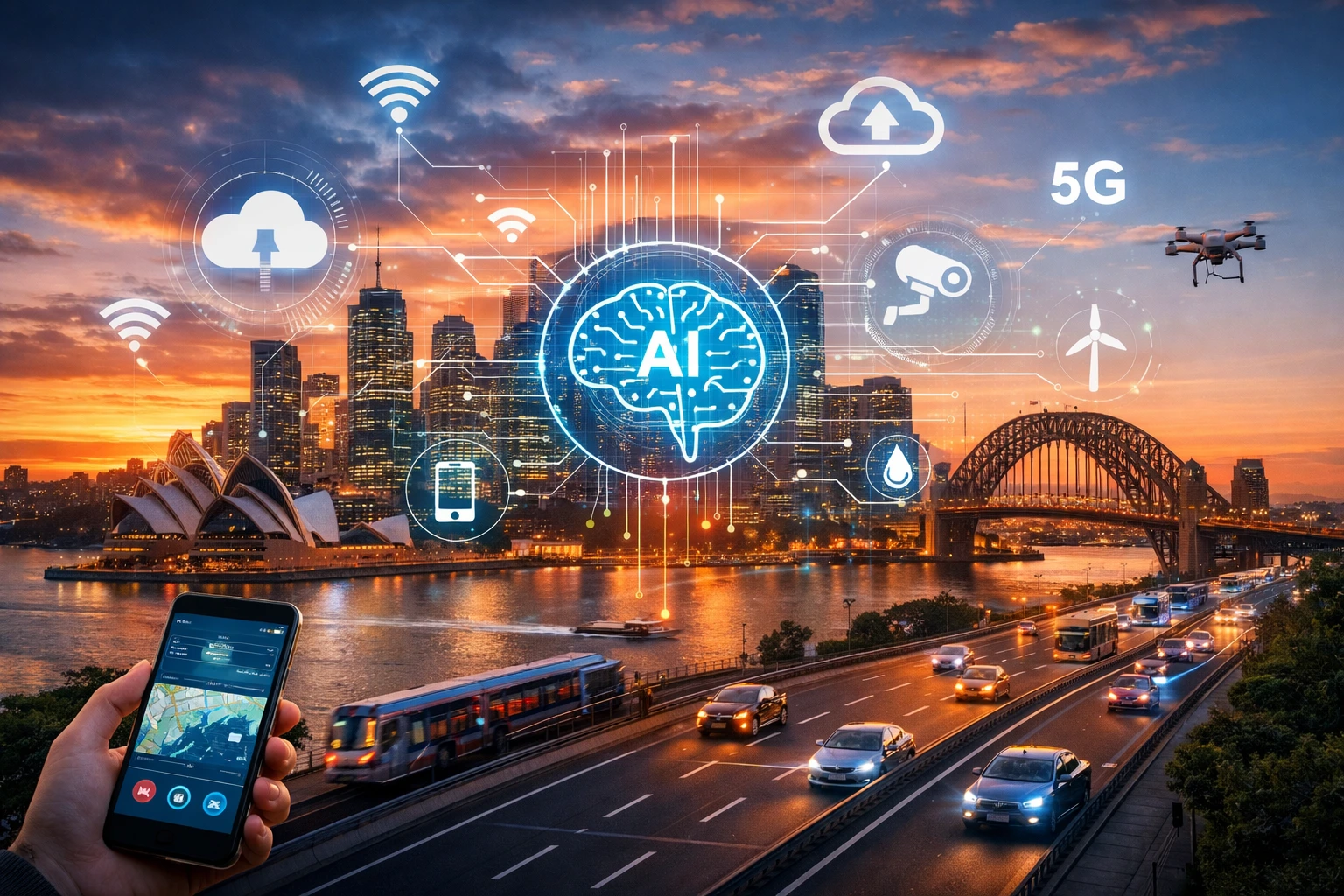
At 8:20 AM on a weekday in Sydney, thousands of commuters move across the city. Trains arrive almost exactly when transport apps predict them. Traffic lights change as congestion builds at intersections. Parking apps show open spots before drivers reach the street.
Most people never think about why this happens.
Behind these everyday moments, artificial intelligence, IoT sensors, and urban data systems are already managing parts of modern Australian cities.
Across Sydney, Melbourne, Brisbane, and Adelaide, city infrastructure increasingly relies on AI-powered smart city technologies that analyze massive data streams every second. These systems optimize traffic flow, monitor environmental conditions, and help governments plan urban development more efficiently.
Smart cities are not futuristic experiments anymore. In Australia, they are becoming part of how modern cities function in 2026.
Why Smart Cities Matter in Australia
Australia is one of the most urbanized countries on the planet. The majority of people live in large metropolitan regions where infrastructure faces constant pressure from population growth and economic expansion.
Smart city technologies allow governments to manage cities using real-time data instead of static planning models.
Australia Urbanization Data
| Metric | Latest Data |
| Australians living in cities | 86% of the population |
| Population of Sydney | ~5.3 million |
| Population of Melbourne | ~5.2 million |
| Urban population growth | 1.6% annually |
| Expected national population by 2050 | ~38 million |
This scale of urbanization requires smarter infrastructure systems. Artificial intelligence, digital twins, and Internet of Things (IoT) networks provide the tools cities need to handle that complexity.
The Smart City Market in Australia Is Growing Rapidly
Investment in smart city technology in Australia has accelerated in recent years as governments and technology companies collaborate on digital infrastructure projects.
Smart Cities Market Statistics
| Category | Data |
| Smart city market value (2024) | $39 million |
| Projected market value (2030) | $202 million |
| Growth rate | 33% CAGR |
| Government smart city projects | 100+ nationwide |
| Federal smart city funding | $50+ million |
Much of this investment focuses on technologies that support AI-powered urban infrastructure, smart mobility systems, and sustainable city planning.
The 10 Smart City Projects Quietly Transforming Australia
Several large-scale projects are shaping how AI, data platforms, and connected infrastructure operate across Australian cities. These initiatives combine urban planning, artificial intelligence, IoT networks, and sustainable infrastructure.
Major Smart City Projects in Australia
| Project | City | Technology Used | Purpose |
| Smart Motorways Program | Sydney | AI traffic analytics | Reduce congestion and improve travel time |
| Melbourne Digital Twin | Melbourne | Digital twin simulation | Urban planning and infrastructure modeling |
| Adelaide Smart Lighting | Adelaide | IoT street lighting | Energy efficiency and environmental monitoring |
| Brisbane Flood Monitoring Network | Brisbane | AI climate analytics | Flood prediction and disaster response |
| Western Sydney Smart Infrastructure | Sydney | Smart transport + IoT | Support new airport development |
| Newcastle Smart City Strategy | Newcastle | Urban data platform | Improve transport and city planning |
| Parramatta Smart Parking | Sydney | IoT parking sensors | Reduce congestion from parking search |
| Canberra Smart Energy Grid | Canberra | AI energy optimization | Renewable energy integration |
| Perth Smart Water Monitoring | Perth | Sensor networks | Detect water leaks and optimize supply |
| Gold Coast Mobility Network | Gold Coast | Smart transport data | Integrated mobility planning |
Many of these projects rely on urban data platforms, which allow different city systems to share information in real time.
Artificial Intelligence Is Becoming the Brain of Smart Cities
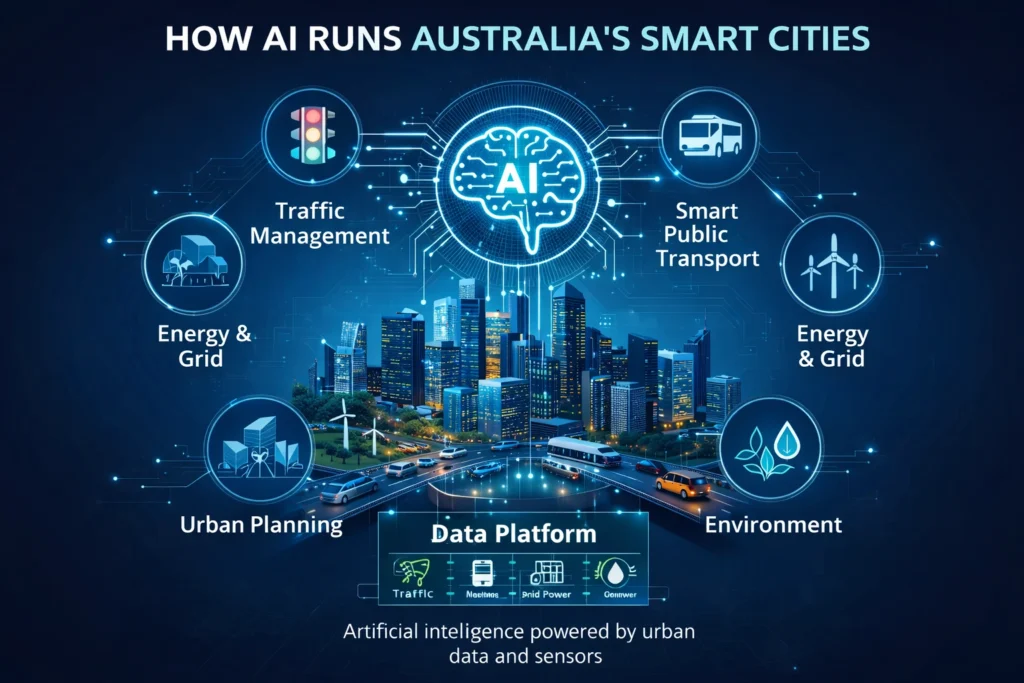
Artificial intelligence forms the analytical layer that allows modern cities to operate efficiently.
AI systems analyze enormous datasets generated by traffic cameras, environmental sensors, public transport networks, and infrastructure monitoring platforms.
These systems allow cities to respond dynamically to changing conditions.
Examples of AI applications in smart cities include:
• Predictive traffic management
• Infrastructure maintenance prediction
• Smart energy grid optimization
• Real-time emergency response analytics
• Environmental monitoring and climate modeling
Urban technology experts emphasize that artificial intelligence is not replacing city planners. Instead, it helps them make faster and more informed decisions.
Andrew Ng, one of the most influential AI researchers, explains the role of AI in infrastructure clearly:
“AI is the new electricity. Just as electricity transformed industries a century ago, artificial intelligence will transform nearly every sector today.”
Urban infrastructure is now one of the sectors experiencing that transformation.
IoT Sensors Are Turning Cities Into Data Networks
Artificial intelligence relies on data, and that data often comes from Internet of Things sensors embedded throughout cities.
Streetlights, roads, public transport networks, waste bins, and environmental monitoring stations all contain devices that collect real-time operational data.
Internet of Things Market in Australia
| Metric | Value |
| IoT market size (2024) | $30.5 billion |
| Forecast market size (2033) | $92.6 billion |
| Growth rate | 13% annually |
These IoT networks allow cities to track:
• Traffic congestion patterns
• Air pollution levels
• Water pipeline leaks
• Parking availability
• Waste management efficiency
The information flows into AI analytics platforms that help city authorities optimize urban services.
Digital Twins Are Changing How Cities Are Designed
One of the most advanced technologies used in smart urban planning is digital twin technology.
A digital twin is a virtual simulation of a real city built using geographic data, infrastructure models, and sensor information.
Cities such as Melbourne and Brisbane increasingly use digital twins to simulate how infrastructure changes affect urban systems.
Urban planners can test scenarios such as:
• New transport routes
• Climate resilience strategies
• Flood mitigation infrastructure
• Energy demand from new housing developments
Fei-Fei Li, a leading AI researcher at Stanford University, highlights the importance of data-driven planning:
“Artificial intelligence is not about replacing humans. It’s about amplifying human insight through data.”
Digital twins provide that insight for city planners.
Smart Transportation Systems Are Already Operating
Transportation remains one of the most visible applications of AI-driven smart city technology.
Traffic congestion costs Australian cities billions of dollars each year. AI traffic management systems help reduce these losses by optimizing road usage.
Sydney’s Smart Motorways program uses machine learning and traffic sensors to monitor vehicle flow across major highways.
The system adjusts speed limits and lane configurations automatically to reduce congestion.
Smart Transportation Technologies in Australian Cities
| Technology | Purpose |
| AI traffic signals | optimize traffic flow |
| Smart parking networks | locate available parking |
| Real-time transit tracking | improve bus and train reliability |
| Electric vehicle infrastructure | support EV adoption |
| Integrated mobility apps | combine multiple transport modes |
These systems improve travel times while reducing fuel consumption and emissions.
Which Australian City Is Leading the Smart City Race?
Different Australian cities focus on different technological priorities. Some invest heavily in transportation systems, while others emphasize climate resilience or digital infrastructure.
Smart City Technology Comparison
| City | Smart Technology Strength | Key Projects |
| Sydney | Smart mobility and traffic AI | Smart Motorways, Smart Parking |
| Melbourne | Digital twin planning and environmental monitoring | Melbourne Digital Twin |
| Brisbane | Climate resilience and flood analytics | Flood Monitoring Network |
| Adelaide | Smart infrastructure and energy efficiency | Smart Lighting Grid |
| Perth | Water management and urban analytics | Smart Water Systems |
Sydney and Melbourne lead in scale and investment, while Brisbane focuses strongly on climate-driven smart infrastructure.
Energy Infrastructure Is Becoming Intelligent
Smart cities also focus heavily on energy efficiency and renewable integration.
Australia’s growing reliance on solar and wind energy requires flexible electricity management systems.
AI-powered smart grids analyze demand patterns and adjust electricity distribution accordingly.
Smart Energy Infrastructure
| Technology | Function |
| Smart electricity grids | balance renewable energy supply |
| Building energy monitoring | reduce electricity waste |
| Smart meters | track household energy consumption |
| Intelligent street lighting | adjust brightness automatically |
Tesla CEO Elon Musk has frequently emphasized the importance of intelligent energy systems:
“Sustainable energy and intelligent infrastructure will define the future of cities.”
Energy optimization remains a central component of smart city development.
Environmental Monitoring Is Becoming Essential
Australia faces environmental challenges such as bushfires, flooding, and extreme heat events.
Smart city technologies provide tools for monitoring these risks more effectively.
Cities deploy environmental sensors that track:
• Temperature changes
• Air pollution
• Humidity levels
• River water levels
• Soil moisture
Predictive analytics models use this data to support disaster preparedness and climate adaptation planning.
Key Smart City Statistics (Quick Facts)
Smart City Data Snapshot
| Category | Data |
| Australians living in urban areas | 86% |
| Smart city market in Australia by 2030 | $202 million |
| IoT market in Australia | $30.5 billion |
| Expected IoT market by 2033 | The expected IoT market by 2033 |
| Global smart city market by 2030 | $1.44 trillion |
These figures show that smart cities represent one of the fastest-growing technology sectors in the world.
Challenges of Smart City Technology
Despite the benefits, smart city development introduces important policy questions.
Large-scale data collection requires strong cybersecurity protections and transparent governance frameworks.
Urban technology experts often highlight several key concerns:
• Cybersecurity risks in connected infrastructure
• Data privacy and digital surveillance concerns
• Integration challenges between government agencies
• Long-term maintenance costs
Responsible governance plays a crucial role in maintaining public trust.
The Future of Smart Cities in Australia
Artificial intelligence, 5G networks, and edge computing continue to expand the capabilities of urban infrastructure.
Urban systems increasingly function as interconnected digital ecosystems where data flows between transportation networks, energy grids, and environmental monitoring systems.
Possible developments in the next decade include:
• Autonomous public transportation networks
• Predictive infrastructure maintenance
• Fully integrated city data platforms
• Climate-adaptive urban planning systems
AI pioneer Geoffrey Hinton once noted:
“The impact of artificial intelligence will be comparable to the Industrial Revolution.”
For cities, that transformation is already underway.
Why This Matters for Everyday Life
Smart city technologies rarely appear dramatic.
They operate quietly in the background, influencing daily experiences such as commute times, air quality monitoring, and energy efficiency.
As Australian cities continue to grow, these technologies help governments manage infrastructure more effectively while improving the quality of urban life.
For residents, the result is often subtle: smoother transportation systems, better environmental monitoring, and smarter public infrastructure.
Behind these improvements lies an expanding ecosystem of artificial intelligence, smart infrastructure, and urban data systems shaping the future of cities.
FAQs
Which Australian cities are considered smart cities?
Sydney, Melbourne, Brisbane, Adelaide, and Perth are among the leading smart cities in Australia. These cities use AI traffic systems, smart energy grids, digital twin models, and IoT sensor networks to improve infrastructure and public services.
How is artificial intelligence used in smart cities?
Artificial intelligence in smart cities analyzes real-time data from traffic cameras, sensors, and infrastructure systems. This helps optimize traffic flow, monitor environmental conditions, predict infrastructure maintenance, and improve emergency response.
What technologies are used in smart cities?
Smart cities use several technologies, including artificial intelligence, Internet of Things (IoT) sensors, digital twins, 5G networks, smart grids, and urban data platforms. These technologies allow cities to monitor and manage infrastructure in real time.
Why are smart cities important for the future?
Smart cities help governments manage population growth, reduce energy consumption, improve transportation systems, and respond more effectively to environmental challenges such as climate change and urban congestion.
Similar Posts
5 Myths About People with Disabilities Debunked
Oral Care in 2026: How Tech-Driven Clinics in Australia Enhance Patient Outcomes
Key Differences of Office 2024 LTSC vs Microsoft 365 (Office 365)